

REALTIMEais Partner Network · Services
Turn NFPA 70B from a requirement into a working Electrical Maintenance Program your team can run and prove.


NFPA 70B Consulting and EMP Development The need
NFPA 70B is now a standard, not a recommended practice. It calls for a written Electrical Maintenance Program (EMP), maintenance intervals based on equipment condition, and records that prove the work was done.
Most facilities maintain equipment. Few can show a documented program behind it. That gap affects more than an audit: NFPA 70E relies on equipment being properly maintained, so missing maintenance records weaken your arc flash risk assessments too.
Scope
- 70B gap analysis of your current maintenance practices, records, and written program
- REALTIMEais 70B READINESS SCORE assessment: 59 criteria across 8 weighted domains
- Written EMP development or revision, including roles, responsibilities, and review cycle
- Equipment inventory strategy and criticality ranking
- Condition assessment method and maintenance interval plan
- Roadmap with prioritized actions, owners, and target dates
Deliverables

70B Readiness Score report with a score by domain and an overall compliance tier
Written Electrical Maintenance Program document
Prioritized corrective action plan
Maintenance schedule loaded and ready to run in EMP Optimizer
Management summary for leadership and safety committees
Discuss your project
Tell us where the work is and what you need. The Partner Network Team will match you with qualified experts and reply within one business day.
or call 866-558-4313


Your EMP does not end as a binder. The program is built inside REALTIMEais, so the plan and the proof live together.
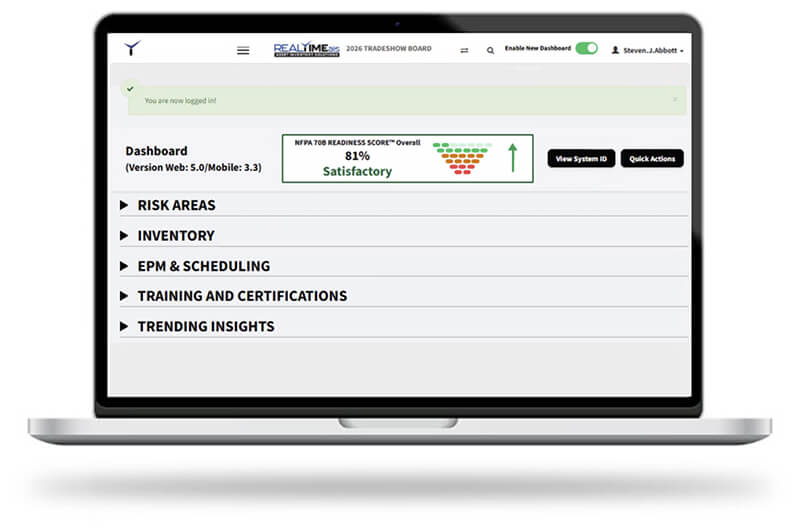

EMP Optimizer schedules maintenance from each asset’s condition and criticality.
Asset Manager stores every device, task record, and test form behind the program.
The Readiness Score can be re-run to show progress over time.
The three engagement options
01
Network-managed project
The Partner Network Team scopes the work, assigns qualified partners, and coordinates the project from kickoff to closeout. One proposal and one point of contact.
Best for Multi-site programs, projects that need several disciplines, or teams that want it handled end to end
02
Partner-led project
You work directly with a qualified Network partner in your area, under that partner's own contract. The work is performed and documented in REALTIMEais.
Best for Facilities that want a local team and an ongoing relationship
03
Partner-led with Network oversight
Your Network partner performs the work and a REALTIMEais project consultant adds scope review, quality checks, and closeout verification.
Best for Higher-risk or first-time projects where a second set of expert eyes matters
Whichever option you choose, every finding, report, and record lands in your REALTIMEais platform.

Built on 35 years of electrical safety consulting and program gap analysis audits
A defined scoring method: 59 criteria, 8 weighted domains, three compliance tiers
Delivered on the first NFPA 70B-native platform, so the program is usable the day it is finished
[Customer result or quote: to be added when approved]
Frequently asked
What is an Electrical Maintenance Program?
A written, managed program that defines how your electrical equipment is inventoried, assessed, maintained, and documented. NFPA 70B requires one.
We already do preventive maintenance. Do we still need this?
Probably. Doing maintenance and having a documented program are different things. The gap analysis shows exactly what is missing.
What does the 70B Readiness Score tell us?
Where you stand in each of 8 domains and overall: Satisfactory Compliant (80–100%), Partially Compliant (50–79%), or At Risk (0–49%).
How long does EMP development take?
It depends on the number of facilities and the state of your current records. We give you a timeline with the scope.
Do you need to visit our site?
A site visit is typical for the gap analysis. Document review and program writing can be done remotely.
Find out where your 70B program stands
One conversation gets you a scoped plan, a qualified team, and a single system of record for everything they deliver.
 or call 866-558-4313