
How Electrical Preventive Maintenance Became a Standard — and How Technology-Ready Contractors Will Own It
For more than two decades, the electrical industry has been shaped by NFPA 70E. Arc flash studies, incident energy labels, PPE programs, and qualified electrical worker training became a defining wave of work for contractors and consultants alike. That wave built businesses — but it had a ceiling. Once a facility completed its study and stood up its safety program, the ongoing work narrowed to periodic reviews and refresher training.
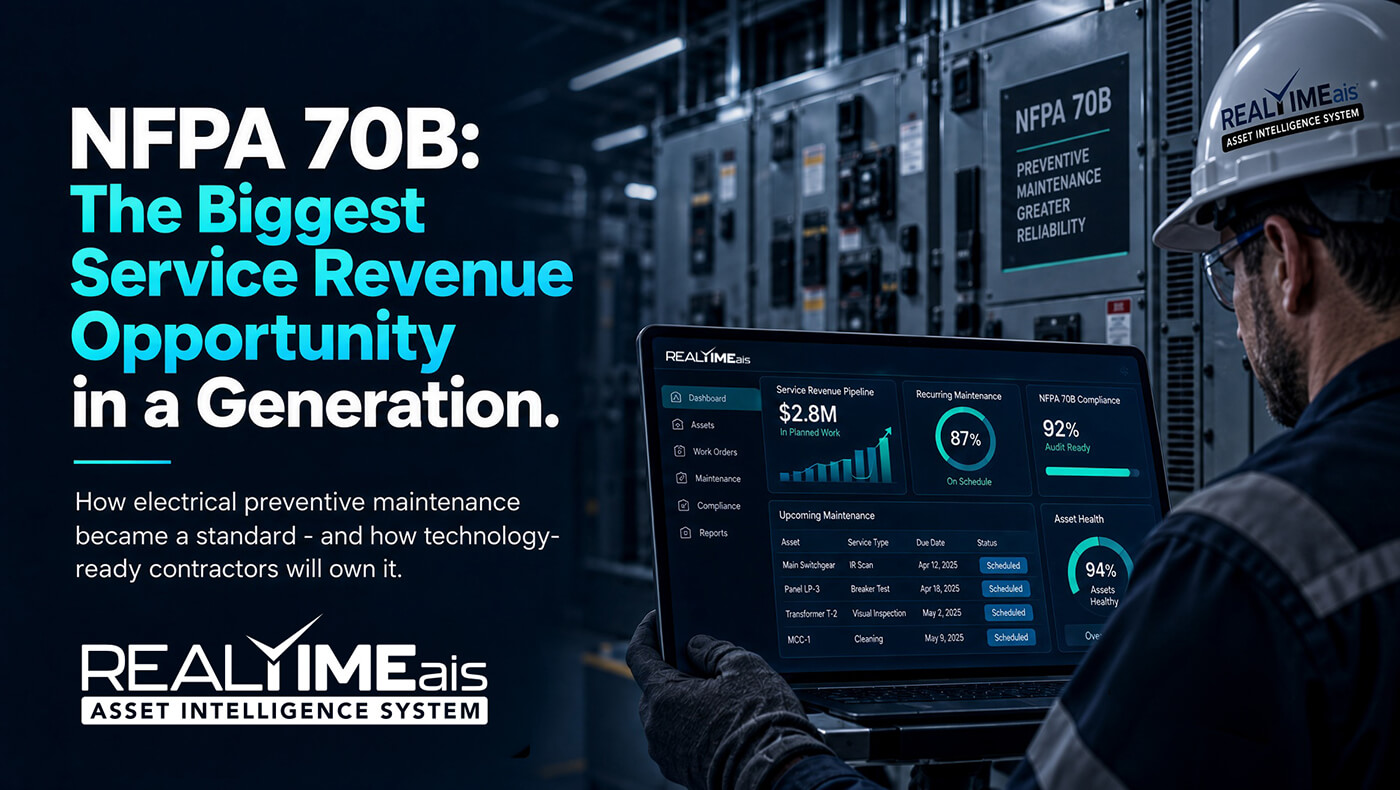
NFPA 70B is different. When the Standard for Electrical Equipment Maintenance moved from a recommended practice to an enforceable standard, it created something 70E never did: a recurring, ongoing obligation on every facility owner to maintain their electrical equipment under a documented, condition-based program. Maintenance is not a project that ends. It is a cycle that repeats — assessment, task, documentation, reassessment — for the life of every asset in every facility. For contractors, that means the 70B opportunity does not peak and fade the way the 70E study wave did. It compounds, year after year, at every customer site.
The Shift: From Recommended Practice to Standard
NFPA 70B spent decades as a recommended practice — useful guidance that owners could take or leave. Its elevation to a standard changed the language and the stakes. “Should” became “shall.” Insurers, OSHA’s general duty framework, and corporate risk managers now have a recognized consensus standard to point to when they ask a simple question: can you show us your electrical maintenance program?
Most facility owners cannot. The typical industrial or commercial facility has no complete inventory of its electrical assets, no baseline condition assessment, no condition-of-maintenance documentation, and no defined maintenance intervals tied to criticality and condition. What they have is a reactive habit: run equipment until something fails, then call for emergency service. The standard now requires them to replace that habit with a documented electrical maintenance program — and very few owners have the staff, the expertise, or the systems to build and sustain one on their own.
That gap between what the standard requires and what owners can actually do internally is the contractor opportunity. Every requirement in the standard translates into a service an electrical contractor is positioned to sell, perform, and repeat.
Why 70B’s Trajectory Is Bigger Than 70E’s
The 70E era rewarded contractors with project work: a study, a set of labels, a training class. Valuable — but largely transactional. A facility could complete the work and not need the contractor again for years.
70B is structurally incapable of being one-and-done. Condition-based maintenance requires ongoing inspection, testing, cleaning, thermographic scanning, and corrective work on defined intervals — and every one of those activities generates documentation the owner must maintain and update. The condition of the equipment found during this cycle drives the schedule for the next cycle. The program never closes out. Contractors who position themselves as the maintenance program partner — not just the emergency responder — embed themselves in a client’s operations permanently. Each visit produces findings; findings produce corrective work; corrective work produces updated documentation and the next scheduled visit. This is what a perpetual service revenue model looks like, and it applies to every facility with electrical distribution equipment — which is to say, every facility.
What the Standard Requires — and What That Means in Billable Services
The owner-facing “shall” requirements translate directly into a concrete service catalog:
- Asset inventory — identifying, labeling, and cataloging every piece of electrical distribution equipment in the facility. For most sites, this has never been done completely, and it is the natural first engagement.
- Baseline condition assessment — establishing the current condition of maintenance for each asset, which determines everything that follows.
- Condition-driven maintenance intervals — building the maintenance schedule from asset condition and criticality rather than a flat calendar, so resources go where risk actually lives.
- The documented electrical maintenance program — the written program, procedures, records, and evidence of execution the owner must be able to produce for insurers, auditors, and regulators.
- Ongoing execution — the recurring inspections, tests, thermography, cleaning, torque checks, and corrective repairs that keep the program alive and the documentation current.
Each item is a distinct, provable, invoiceable service. Together they form a ladder: the inventory leads to the assessment, the assessment leads to the program, and the program leads to a service relationship with no natural end date.
Technology: Not a Nice-to-Have, but the Delivery Mechanism
A preventive maintenance program is, at its core, an information problem: thousands of assets, each with a condition, a criticality, a task list, an interval, and a documentation trail. Managing that on spreadsheets and paper forms is possible in theory and ruinous in practice — slow to capture, impossible to keep current, and painful to produce when an insurer or auditor asks for records.
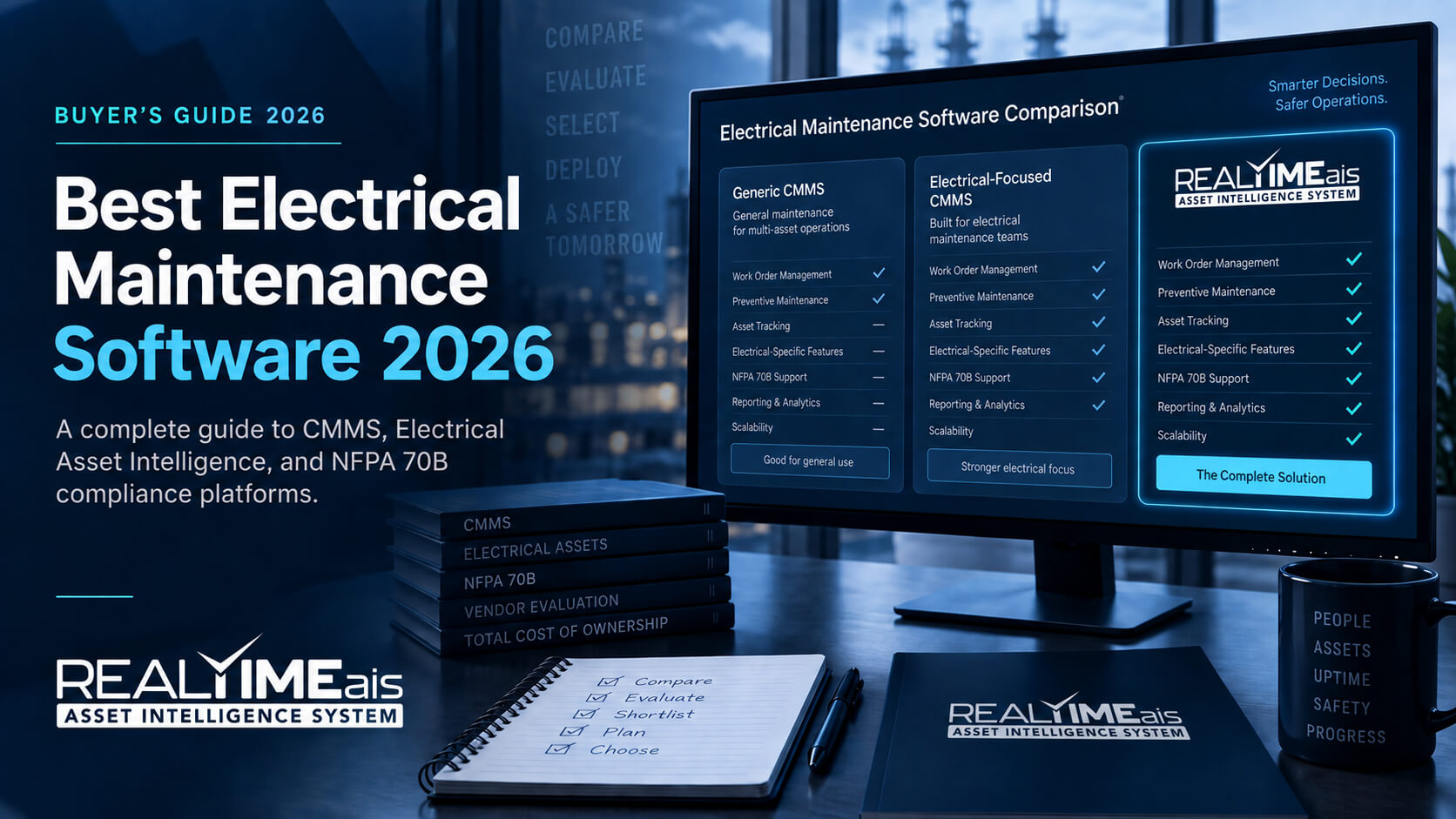
This is exactly the problem REALTIMEais was built to solve. As the industry’s first NFPA 70B-native platform — The Electrical Intelligence System™ — REALTIMEais.com was designed around the standard itself rather than retrofitted to it. The Asset Manager module handles the inventory and baseline condition assessment: technicians capture assets, photos, nameplate data, and condition-of-maintenance ratings on a mobile device right at the equipment. The EMP Optimizer builds the condition-driven maintenance schedule the standard requires, recalculating intervals automatically as asset conditions change. REALTIME Risk keeps arc flash and electrical safety documentation aligned with the maintenance record, and REALTIME Training tracks the workforce qualifications behind the program.
For a contractor, the effect is an efficiency multiplier. Field data capture happens once, at the asset — not on paper transcribed later. Documentation that used to take administrative days assembles itself into client-ready deliverables. More assets get covered per technician-hour, and the client sees the contractor’s value in a living compliance record every single month.
Just as important, the platform becomes the relationship. When the contractor manages the client’s electrical asset intelligence in REALTIMEais — the living record of what they own, what condition it is in, and what is due next — switching to a low-tech competitor means the client walks away from their own compliance record. Technology-forward contractors are not just more efficient; they are structurally harder to displace. That is why REALTIMEais offers a Partner Network for electrical contractors: the platform, the NFPA 70B methodology, and the training to deliver maintenance programs as a packaged, repeatable service line.
The Workforce Reality: Digital Skills for the Typical Technician
The efficiency edge comes with an honest prerequisite. A platform-based maintenance program is only as good as the data captured in the field, and that puts a baseline set of digital skills on every service technician’s tool list — right alongside the meter and the torque wrench.
This is not about turning electricians into IT staff. It is about a defined, teachable set of competencies: navigating a mobile app confidently, capturing usable photos and readings at the asset, entering condition data accurately and completely, scanning and associating equipment labels, syncing work in the field, and doing basic troubleshooting when a device or connection misbehaves. On the office side, service managers and coordinators need comparable fluency in the platform’s scheduling, reporting, and client-deliverable functions.
This is also where platform choice matters. REALTIMEais was built for the typical technician, not the power user — guided data collection workflows keep field entries complete and consistent, and the REALTIME Training module gives contractors a structured way to onboard crews, close skill gaps, and document who is qualified to do what. Contractors who invest a modest amount in digital readiness unlock the full efficiency of the technology; those who skip this step buy software and get spreadsheets with extra steps.
The Bottom Line
NFPA 70B has created the largest ongoing service opportunity the electrical trades have seen in a generation — a recurring obligation on every facility owner, a service catalog written directly into the standard, and a compounding revenue trajectory for the contractors who move first. The winners will be decided by two capabilities: a platform built for the standard, and a workforce ready to use it.
See how the platform works at REALTIMEais.com, or set up a demo to talk through building NFPA 70B services into your business https://realtimeais.com/electrical-asset-management-software/#book_demo.