

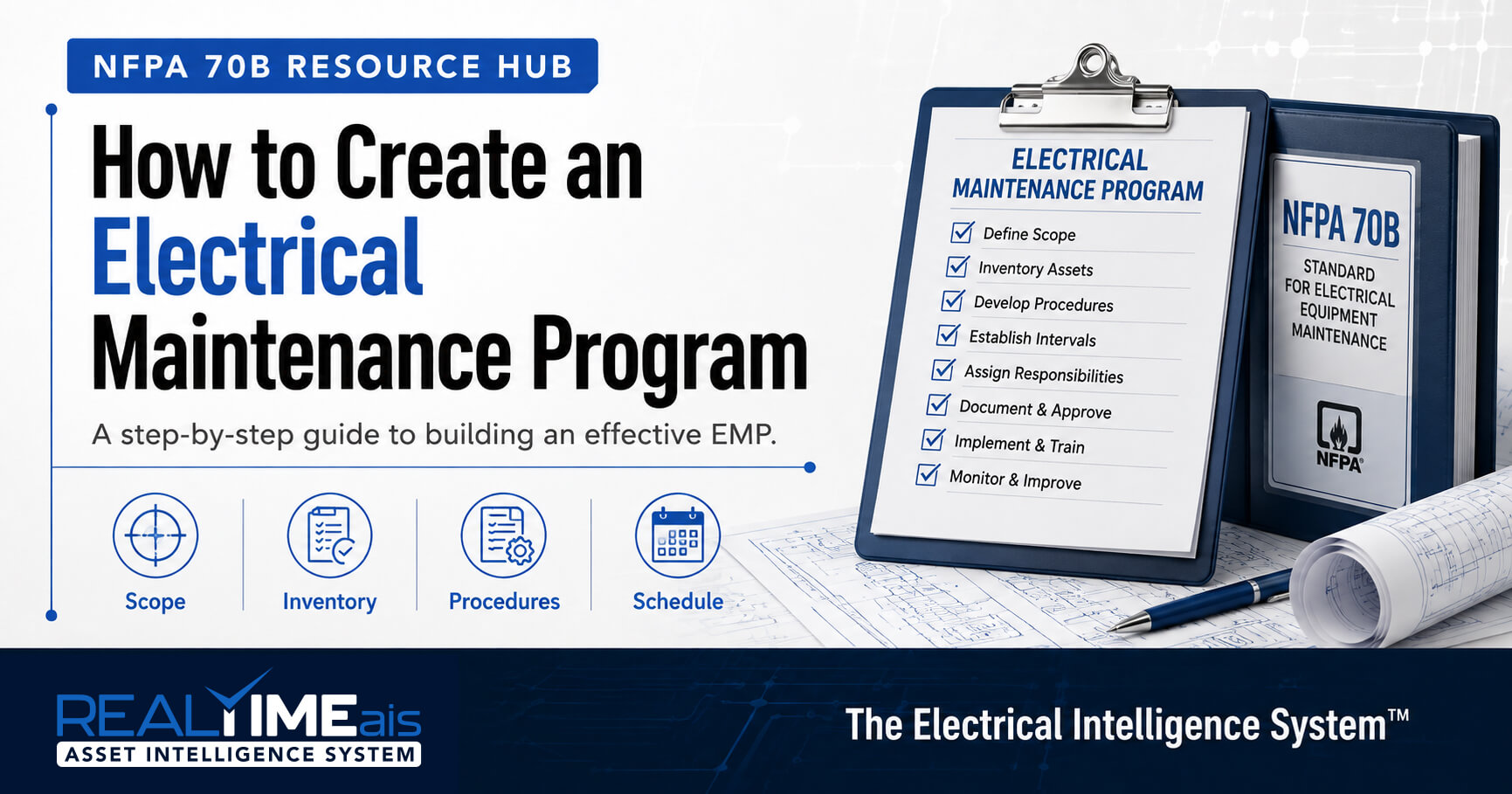
NFPA 70B Resource Hub – Published by REALTIMEais
How to Create an Electrical Maintenance Program (EMP) per NFPA 70B
Everything Facility Managers, Electrical Engineers, and Safety Professionals Need to Know About the Mandatory Standard for Electrical Equipment Maintenance
Key Takeaways
- NFPA 70B changed from a recommended practice to a mandatory standard in 2023.
- A compliant program requires an Electrical Maintenance Program, condition assessments, maintenance intervals, documentation, and regular review.
- REALTIMEais can be positioned as the platform that automates the moving parts: inventory, scoring, scheduling, audit trail, and reporting.
1. What Is an Electrical Maintenance Program?
An Electrical Maintenance Program (EMP) is the formal, documented system that governs how every piece of electrical equipment in your facility is inspected, tested, maintained, and replaced. It is the central requirement of NFPA 70B – the mandatory standard for electrical equipment maintenance.
An EMP is not a collection of work orders. It is not a spreadsheet of equipment. It is not an annual thermographic survey. It is a comprehensive, living program with defined scope, documented procedures, condition-driven scheduling, qualified personnel, complete record-keeping, and annual review. The EMP is what OSHA, insurance auditors, and legal counsel will ask to see when evaluating whether your organization maintains its electrical systems to recognized industry standards.
The 2023 edition of NFPA 70B made EMPs mandatory. The 2026 edition (published September 12, 2025) expanded the requirements significantly – adding cross-site standardization, data-driven maintenance decisions, and more prescriptive documentation expectations. This guide walks through every component of a compliant EMP and provides a step-by-step process for building one from scratch.
2. The Seven Required Components of a Compliant EMP
NFPA 70B defines specific elements that every EMP must contain. Think of these as the structural requirements – if any one is missing, the program is incomplete and non-compliant.
| # | Component | What NFPA 70B Requires |
|---|---|---|
| 1 | Scope & Objectives | Documented purpose of the program, the equipment categories it covers, measurable compliance goals, and organizational commitment to maintaining the program. |
| 2 | Equipment Inventory | Complete, current inventory of all electrical equipment subject to the program with unique identifiers, nameplate data, installation dates, locations, and criticality ratings. |
| 3 | Condition Assessment | Every asset assigned a condition level (1, 2, or 3) based on documented inspection and testing results. Levels updated after every inspection cycle. Criteria documented and consistent across assessors. |
| 4 | Maintenance Procedures | Documented procedures for each equipment type covering visual inspection, testing methods, cleaning, lubrication, calibration, and functional testing. Specific to the equipment, not generic work orders. |
| 5 | Maintenance Schedule | Intervals determined by equipment condition level per Chapter 9 framework. Dynamic scheduling that adjusts when condition levels change. Not static calendar-based PM. |
| 6 | Qualified Personnel | All maintenance performed by qualified persons with demonstrated competence in the specific equipment and procedures. Training records maintained. Qualifications verified before assignment. |
| 7 | Record-Keeping & Review | Complete maintenance records for every asset (dates, results, personnel, corrective actions). Historical condition data. Annual program review with documented findings and updates. Records retrievable for audits. |
The 2026 edition adds an eighth implicit requirement: cross-site standardization. Organizations with multiple facilities must maintain consistent maintenance tasks, testing methods, and acceptance criteria across all locations. This effectively requires a centralized digital platform.
3. How to Build Your EMP: Eight Steps
[Web Developer: Implement HowTo schema (JSON-LD) on this section for Google rich results]
Step 1: Define Scope and Objectives
Start by documenting what the EMP covers and what it aims to achieve. Your scope statement should define the specific equipment categories included (switchgear, transformers, panelboards, MCCs, disconnects, protective devices, cables, grounding systems), the facilities and locations covered, any equipment exclusions with documented justification, and the regulatory standards the program satisfies (NFPA 70B-2026, NFPA 70E, IEEE 1584).
Your objectives should be measurable. Examples: “All electrical assets inspected within their condition-driven interval with zero overdue items.” “Condition Level 3 findings resolved within 30 days of identification.” “System studies current within the five-year mandatory interval at all facilities.” Vague objectives like “maintain electrical equipment safely” are not adequate.
Assign an EMP owner – the person with organizational authority and accountability for the program. This is typically a facility manager, maintenance director, or reliability engineer. Document the reporting structure and escalation path for critical findings.
Step 2: Build Your Electrical Asset Inventory
You cannot maintain what you have not identified. Build a complete inventory of every electrical asset subject to the EMP. For each asset, document: a unique asset identifier (consistent across all records), equipment type and category, manufacturer, model, and serial number, nameplate data (voltage, amperage, kVA/HP ratings), installation date, physical location (building, floor, room, position), feeder source (what upstream device feeds this equipment), criticality rating (how critical is this asset to operations and safety), and current condition level (assigned during baseline assessment in Step 4).
The inventory should map the electrical system topology – not just list assets in a flat table. Understanding that Panelboard 2A is fed from Switchgear Main Bus A, which is fed from Transformer T1, which is fed from the utility service, is essential for understanding cascading risk and for coordinating system studies.

How REALTIMEais Helps
REALTIMEais helps organize your electrical asset inventory with topology mapping built in. Assets are organized by their actual electrical relationships – not just by building and room. Import existing data from spreadsheets, CMMS exports, single-line diagrams, or arc flash study reports. The platform structures the data into a proper electrical hierarchy with condition scoring ready to populate.
Step 3: Document Maintenance Procedures by Equipment Type
For each equipment category in your inventory, document the specific maintenance procedures that your program requires. These are not generic work orders – they are detailed, equipment-specific procedures that define exactly what to inspect, test, and maintain.
Each procedure should include: the equipment type and applicable models, required tools and test equipment, safety requirements and PPE (reference your NFPA 70E procedures), step-by-step inspection and testing instructions, acceptance criteria and pass/fail thresholds for each test, corrective action requirements for out-of-specification findings, and the data points that must be recorded during the procedure.
NFPA 70B provides guidance on maintenance procedures by equipment type throughout the standard. Your procedures should align with this guidance while incorporating manufacturer recommendations and any industry-specific requirements for your facility.
Step 4: Conduct Baseline Condition Assessments
With your inventory in place and procedures documented, assess every electrical asset and assign an initial condition level. The baseline assessment establishes the starting point for your condition-based maintenance schedule.
A complete baseline assessment typically includes: visual inspection of the equipment’s physical state, infrared thermographic survey under loaded conditions, insulation resistance testing for applicable equipment, contact resistance measurements on critical connections, protective device functional testing, review of any existing maintenance records, test data, or incident history, and documentation of findings with the specific evidence supporting the assigned condition level.
Prioritize the baseline assessment by criticality. Start with: main switchgear and distribution equipment, transformers, equipment with known issues or previous failures, equipment in harsh environments (moisture, heat, contamination), and the oldest equipment in the inventory. Complete the full inventory assessment as quickly as resources allow, but do not let the perfect be the enemy of the good – a partial assessment on critical equipment is better than no assessment at all.
Step 5: Generate the Maintenance Schedule
With condition levels assigned, generate the maintenance schedule by mapping each asset’s condition level to the appropriate interval table from NFPA 70B Chapter 9.
For each asset, the schedule must specify: every maintenance activity required for that equipment type, the interval for each activity based on the current condition level, the specific due date for the next occurrence of each activity, and the qualified person or team responsible for performing the work.
This is where the EMP Optimizer concept becomes critical. In a facility with hundreds of electrical assets, each with multiple maintenance activities at different intervals determined by individual condition levels, generating the schedule manually is a massive cross-referencing exercise. A purpose-built system that automates this calculation – and recalculates dynamically when condition levels change – is not a luxury. It is a practical necessity for any facility beyond a handful of assets.
The EMP Optimizer
REALTIMEais’s EMP Optimizer module generates a fully NFPA 70B-compliant maintenance calendar across your entire electrical asset inventory automatically. It cross-references each asset’s equipment type and current condition level against the Chapter 9 interval framework, calculates specific due dates for every maintenance activity, and recalculates in real time when condition assessments change. What takes days of manual spreadsheet work takes the EMP Optimizer seconds.
Step 6: Define Qualified Personnel Requirements
NFPA 70B requires that all maintenance be performed by qualified persons with demonstrated competence in the specific equipment and procedures involved. Your EMP must document: the qualification requirements for each type of maintenance activity, the training and certification requirements for maintenance personnel, the process for verifying qualifications before assigning work, training records for all personnel performing work under the EMP, and the refresher training schedule.
Qualification is not just about electrical knowledge – it includes specific competence in the equipment being maintained and the testing procedures being performed. An electrician qualified to work on 480V switchgear may not be qualified to perform insulation resistance testing on a 15kV transformer without additional training. Document these distinctions explicitly.
The personnel requirements should align with your NFPA 70E electrical safety program. Workers performing maintenance on electrical equipment need both 70B procedural competence (how to perform the maintenance) and 70E safety competence (how to protect themselves while performing it).
Step 7: Establish Record-Keeping Protocols
Every action in your EMP must be documented. The record-keeping system is your compliance evidence – what you present to OSHA, insurance auditors, and legal counsel when asked to demonstrate your program.
For every maintenance activity, your records must capture: the asset identifier and location, the date and time the activity was performed, the identity of the person who performed the work, the procedure followed, all inspection findings and test results with specific values, the condition level assessment based on the findings, any corrective actions required, corrective action completion date and verification, and the identity of the person who reviewed and approved the record.
For the program overall, maintain: historical condition assessment records showing how each asset’s condition has changed over time, maintenance compliance metrics (percentage of activities completed on schedule, overdue items, average condition scores by equipment type), corrective action tracking (open items, average resolution time, escalation history), and annual program review records documenting findings and updates made.
The 2026 edition explicitly requires that inspection and testing data be used for trend analysis and resource prioritization. This means your record-keeping system must be capable of aggregating data across assets, equipment types, and time periods – not just storing individual activity records. Paper-based and spreadsheet-based systems cannot deliver this at scale.
Step 8: Implement the Annual Program Review
NFPA 70B requires that the EMP be reviewed at least annually. The annual review is not a formality – it is the mechanism that ensures your program evolves based on actual results and operational experience.
The annual review should evaluate: program effectiveness – are condition scores improving, stable, or declining across the asset base? Schedule compliance – what percentage of maintenance activities were completed on time? Common findings – are certain equipment types, locations, or environmental factors producing recurring Level 2 or Level 3 scores? Corrective action performance – are Level 3 findings being resolved within target timeframes? Procedure adequacy – do any maintenance procedures need to be updated based on equipment changes, new testing methods, or lessons learned? Personnel adequacy – are there gaps in qualified personnel coverage? Resource allocation – is the maintenance budget aligned with the condition-driven priorities? And standard updates – have NFPA 70B, 70E, or related standards been revised since the last review?
Document the review findings, the decisions made, and the specific updates implemented. This documentation demonstrates continuous improvement – a key element of a mature compliance program.
4. EMP Document Structure: What to Include
Your EMP should be organized as a structured document (or set of documents) that can be presented to auditors, inspectors, and stakeholders as a complete program description. Here is a recommended structure:
| # | Section | Contents |
|---|---|---|
| 1 | Program Overview | Purpose, scope, objectives, applicable standards, organizational commitment statement, EMP owner and reporting structure. |
| 2 | Equipment Inventory | Complete asset list with unique IDs, nameplate data, locations, criticality ratings, and system topology. Reference to the digital inventory system if applicable. |
| 3 | Condition Assessment Criteria | Documented Level 1/2/3 scoring criteria by equipment type with specific, measurable thresholds. Assessor training and calibration requirements. |
| 4 | Maintenance Procedures | Equipment-specific procedures for inspection, testing, cleaning, and maintenance. Acceptance criteria and corrective action triggers for each procedure. |
| 5 | Maintenance Schedule | Condition-driven interval tables by equipment type. Reference to the scheduling system and the process for dynamic interval adjustment when condition levels change. |
| 6 | System Studies | Five-year study interval tracking for short-circuit, coordination, and incident energy analyses. System change triggers and the process for initiating interim updates. |
| 7 | Personnel Qualifications | Qualification requirements by activity type, training records, certification tracking, and the process for verifying competence before work assignment. |
| 8 | Record-Keeping | Documentation requirements for every maintenance activity. Data retention policies. Audit trail requirements. Trend analysis and reporting protocols. |
| 9 | Program Review | Annual review process, evaluation criteria, documentation requirements, and the process for implementing program updates based on review findings. |
| 10 | Appendices | Reference documents: single-line diagrams, arc flash study summary, testing forms, corrective action templates, training curricula, vendor manuals for critical equipment. |
5. Realistic Timeline: How Long Does It Take?
The timeline for building a compliant EMP depends on your starting point and facility size:
| Starting Point | Timeline | What’s Involved |
|---|---|---|
| Starting from zero | 90-180 days | Full asset inventory, baseline condition assessments, procedure documentation, schedule generation, system study verification, record-keeping system implementation, personnel qualification audit. |
| Existing informal program | 60-90 days | Formalize existing practices into documented EMP structure, fill gaps in inventory and condition data, implement digital tracking, establish annual review process. |
| 2023 EMP needs 2026 upgrade | 30-60 days | Gap assessment against 2026 requirements, add cross-site standardization, formalize data-driven decision processes, update condition assessment criteria, verify system study intervals. |
| Using REALTIMEais | Days, not months | Import asset data, configure condition criteria, run EMP Optimizer to generate compliant schedule, begin executing. The platform provides the structure; you provide the data. |

Don’t Wait for Perfection
The biggest mistake organizations make is delaying EMP implementation until they can build a “perfect” program. Start with your critical equipment. Document what you have. Begin condition assessments on your most important assets. Build the program iteratively. A documented, partially implemented EMP is dramatically better – legally, operationally, and from a safety standpoint – than no EMP at all.
6. Why Manual EMP Programs Fail
Organizations that attempt to manage their EMP using spreadsheets, paper forms, and generic CMMS encounter five predictable failure modes:
6.1 The Schedule Drifts
When a condition assessment changes, someone has to manually update the maintenance interval for that specific asset in the scheduling system. In a facility with hundreds of assets and condition changes happening after every inspection cycle, manual schedule updates get missed. The schedule drifts out of sync with actual equipment conditions, and the compliance gap widens silently.
6.2 Documentation Is Incomplete
Paper-based and spreadsheet-based records are inherently incomplete. Inspectors forget to record a finding. Test results get written on a clipboard and never transferred to the system of record. Corrective actions are completed but never documented as closed. When an auditor asks for the maintenance history of a specific asset, the organization cannot produce a complete, traceable record.
6.3 Trend Analysis Is Impossible
The 2026 edition requires using condition data for trend analysis. Spreadsheets can store data, but they cannot aggregate it across hundreds of assets, identify deterioration patterns, flag assets with declining trajectories, or generate trend reports on demand. Without a system designed for data analysis, the trend analysis requirement is effectively unachievable.
6.4 Cross-Site Standardization Breaks Down
When each facility runs its own spreadsheet or paper-based program, procedures inevitably diverge. Different assessors use different criteria. Different sites follow different schedules. Different locations document findings differently. The 2026 edition’s cross-site standardization requirement is impossible to meet without a centralized digital platform.
6.5 The Program Dies When the Champion Leaves
Manual programs are person-dependent. When the facility manager or maintenance director who built the program leaves the organization, the institutional knowledge leaves with them. The spreadsheets stop being updated. The paper forms pile up unprocessed. The program dies. A digital platform with structured workflows survives personnel changes because the process is embedded in the system, not in a person’s head.
REALTIMEais: The EMP That Doesn’t Break
REALTIMEais eliminates every one of these failure modes. Schedules adjust automatically when conditions change. Every action generates a time-stamped audit trail. Trend analysis runs on demand across your entire asset base. Standardized procedures are enforced across all locations from a single platform. And the program persists regardless of personnel changes because the structure, data, and workflows are embedded in the system – not in a spreadsheet on someone’s desktop.

Build Your EMP in Days, Not Months
REALTIMEais provides the structure, automation, and documentation to build a compliant NFPA 70B Electrical Maintenance Program faster than any manual process. Import your asset data, configure your condition criteria, run the EMP Optimizer, and start executing. The platform does the heavy lifting – you provide the expertise.
Call 866-558-4313 | Visit realtimeais.com/demo

About REALTIMEais
REALTIMEais is The Electrical Intelligence System™ — a SaaS platform purpose-built for electrical asset management, NFPA 70B compliance, arc flash safety, and predictive maintenance. Unlike generic CMMS platforms, REALTIMEais was designed from the ground up for the specific requirements of electrical equipment maintenance, with live integrations to FOTRIC AI infrared cameras, GraceSense hot-spot monitoring sensors, ETAP power system analysis software, and Inductive Automation Ignition SCADA systems.
Founded by Steve Abbott, a 30+ year veteran of electrical safety consulting, REALTIMEais combines deep domain expertise with modern software architecture to deliver Quicker, Simpler, Safer compliance for facilities of every size.

Steven J. Abbott
-CEO-
NFPA 70B Hub

Free Resource
NFPA 70B
Compliance Checklist
Compliance Checklist
Evaluate your EMP, documentation, condition assessments, maintenance intervals, system studies, and audit readiness.
Browse by Topic
Not sure where you stand?
Schedule the free readiness audit and receive the checklist as part of the meeting flow.
More NFPA 70B Resources

Schedule Your Free Readiness Audit and
Get Your NFPA 70B Compliance Checklist
As a certified NFPA 70B specialist, I'll help you understand the latest requirements, identify gaps in your current Electrical Maintenance Program, and outline a clear path to compliance. We'll discuss your specific facility, equipment, and challenges in a personalized web meeting.
- A better understanding of your current NFPA 70B compliance state.
- Identification of key areas for improvement in your EMP.
- Practical next steps to build a robust, audit-ready program.
- A free NFPA 70B Compliance Checklist to guide your efforts.
Don't navigate the complexities of NFPA 70B alone.
Let's ensure your facility is safe, compliant, and efficient.

Book a time that works for you