

Published by REALTIMEais
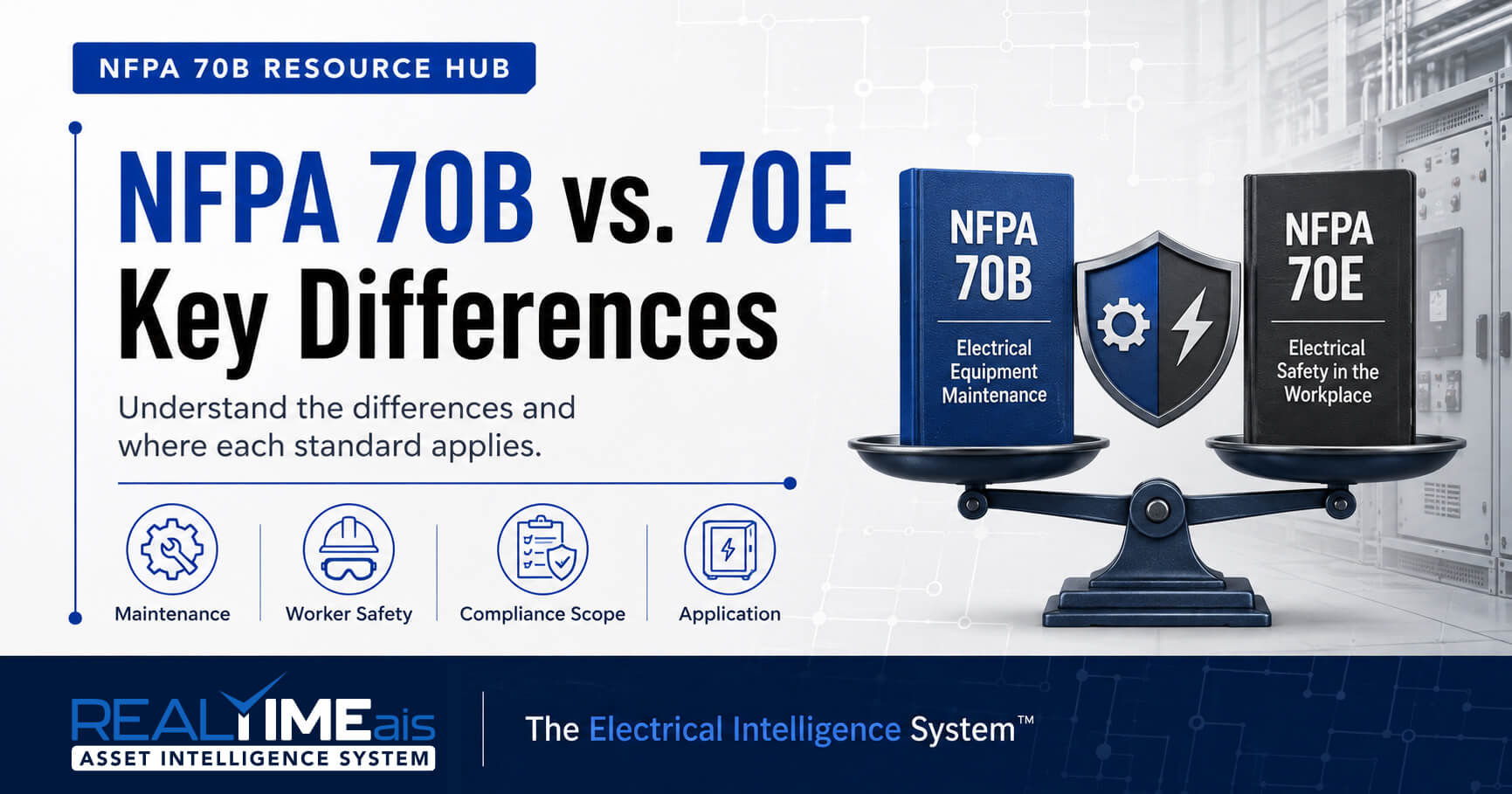
NFPA 70B vs. NFPA 70E: Key Differences Explained
Everything Facility Managers, Electrical Engineers, and Safety Professionals Need to Know About the Mandatory Standard for Electrical Equipment Maintenance
Key Takeaways
- NFPA 70B changed from a recommended practice to a mandatory standard in 2023.
- A compliant program requires an Electrical Maintenance Program, condition assessments, maintenance intervals, documentation, and regular review.
- REALTIMEais can be positioned as the platform that automates the moving parts: inventory, scoring, scheduling, audit trail, and reporting.
1. The Short Answer
NFPA 70B governs electrical equipment maintenance – it tells you how to keep your electrical systems in safe, reliable operating condition.
NFPA 70E governs electrical worker safety – it tells you how to protect people who work on or near energized electrical equipment.
One standard focuses on the equipment. The other focuses on the people. Both are published by the National Fire Protection Association (NFPA), both deal with electrical hazards, and both are critical to any organization that owns or maintains electrical infrastructure. But they address fundamentally different questions, require different compliance activities, and are managed by different teams within most organizations.
The confusion between the two standards is understandable – their numbering is similar, their subject matter overlaps, and many of the same professionals are responsible for both. This guide breaks down exactly how they differ, where they connect, and why you need both.
2. NFPA 70B vs. NFPA 70E: Side-by-Side Comparison
| NFPA 70B | NFPA 70E | |
|---|---|---|
| Full Title | Standard for Electrical Equipment Maintenance | Standard for Electrical Safety in the Workplace |
| Primary Focus | Maintaining electrical equipment to prevent failures, fires, and hazards | Protecting workers from electrical shock, arc flash, and arc blast during work |
| Core Question | Is this equipment maintained properly to prevent failures? | Are workers protected while working on or near this equipment? |
| Status | Standard (mandatory when adopted) – reclassified in 2023 from Recommended Practice | Standard (mandatory when adopted) – has been a standard since its inception |
| Current Edition | NFPA 70B-2023 (2026 edition in development) | NFPA 70E-2024 |
| Who It’s For | Facility managers, maintenance directors, reliability engineers, electrical contractors | Safety managers, electrical workers, supervisors, anyone performing energized or de-energized electrical work |
| Key Requirements | Electrical Maintenance Program (EMP), equipment condition assessments (Levels 1-3), condition-based maintenance intervals, testing procedures, documentation and record-keeping | Arc flash risk assessment, incident energy analysis, PPE selection, approach boundaries, energized work permits, lockout/tagout procedures, training and qualification |
| Equipment Types | All electrical distribution equipment: switchgear, transformers, panelboards, MCCs, disconnects, protective devices, cables, grounding systems | Any electrical equipment that workers interact with during installation, maintenance, or repair |
| Compliance Evidence | Documented EMP, condition assessment records, maintenance logs with dates/results/personnel, program review records | Arc flash labels, incident energy calculations, PPE selection records, energized work permits, training certifications, LOTO procedures |
| OSHA Relevance | Referenced in general duty clause citations related to equipment failures and electrical fires | Directly referenced in OSHA 29 CFR 1910 Subpart S enforcement; widely considered the de facto compliance standard for electrical safety |
| Managed By | Typically: Facilities/Maintenance Department or Reliability Engineering | Typically: EHS/Safety Department |
3. How 70B and 70E Work Together
While the two standards have different scopes, they are deeply connected. NFPA 70B addresses root causes. NFPA 70E addresses consequences. Together, they form a complete electrical safety framework:
3.1 Equipment Condition Affects Worker Safety
Poorly maintained electrical equipment is more likely to fail – and when electrical equipment fails, the most dangerous outcome is an arc flash event. An arc flash releases temperatures exceeding 35,000°F, molten metal shrapnel, a pressure blast wave, and intense light and sound. The severity of an arc flash is measured in incident energy (calories per square centimeter), which determines what PPE workers must wear.
Here is the critical connection: the condition of the equipment directly affects the probability of an arc flash event. Equipment with loose connections, degraded insulation, failed protective devices, or contaminated components is significantly more likely to produce an arc flash than well-maintained equipment. NFPA 70B maintenance reduces the likelihood of the event. NFPA 70E safety practices reduce the severity of injury if the event occurs.
3.2 Maintenance Data Informs Safety Decisions
NFPA 70E requires that arc flash risk assessments be updated when changes occur that could affect the incident energy at a piece of equipment. Equipment condition changes – the kind that NFPA 70B condition assessments are designed to detect – are exactly the type of change that should trigger a 70E reassessment. A transformer that deteriorates from Condition Level 1 to Condition Level 2 may have experienced insulation breakdown that changes fault current characteristics and, therefore, incident energy levels.
Organizations that manage 70B and 70E in silos – maintenance data in one system, safety data in another – miss this connection entirely. When the two datasets are integrated, condition changes automatically flag safety reassessment needs.
3.3 Training Requirements Overlap
Both standards require that personnel be qualified for the work they perform. NFPA 70B requires that maintenance be performed by persons with demonstrated competence in the specific equipment and procedures. NFPA 70E requires that workers be trained on electrical hazards, arc flash risk, PPE selection, and safe work practices. In practice, the same electricians and technicians need training that satisfies both standards – they need to know how to maintain the equipment properly (70B) and how to protect themselves while doing so (70E).

How REALTIMEais Bridges Both Standards
REALTIMEais is the only platform that manages NFPA 70B compliance (through REALTIME Tool) and NFPA 70E safety data (through REALTIME Risk) in a single integrated environment. When a condition assessment changes in REALTIME Tool, the system can flag the corresponding asset in REALTIME Risk for arc flash reassessment. REALTIME Worker manages the training and qualification requirements for both standards. This integration eliminates the silos that cause most organizations to manage 70B and 70E as disconnected programs.
4. Common Misconceptions
Misconception 1: “We comply with 70E, so we’re covered.”
This is the most dangerous assumption in electrical safety. NFPA 70E compliance means your workers are protected during electrical work. It does not mean your equipment is being maintained to prevent failures. A facility can have perfect 70E compliance – every worker wearing the right PPE, every arc flash label current, every energized work permit properly issued – and still suffer a catastrophic equipment failure because no one was maintaining the switchgear, testing the protective devices, or monitoring for thermal anomalies. 70E protects people from hazards. 70B prevents the hazards from developing in the first place.
Misconception 2: “NFPA 70B is only a recommended practice.”
This was true before 2023. It is no longer true. The 2023 edition of NFPA 70B was formally reclassified from a Recommended Practice to a Standard. This means it can be adopted by jurisdictions as enforceable code, referenced in contracts and insurance requirements, and cited by OSHA as a recognized industry standard. Organizations that dismiss 70B as “optional” are operating on outdated information.
Misconception 3: “Our CMMS handles 70B compliance.”
Generic CMMS platforms (eMaint, UpKeep, Limble, Fiix, Maximo) can manage work orders for electrical equipment, but they cannot manage NFPA 70B compliance. They lack the condition assessment framework (the three-tier scoring system that drives maintenance intervals), they have no awareness of NFPA 70B-specific maintenance procedures, they cannot integrate with electrical monitoring technologies, and they have no connection between maintenance condition and arc flash safety data. Managing NFPA 70B in a generic CMMS is like managing financial compliance in a general-purpose spreadsheet – technically possible, practically unmanageable at scale.
Misconception 4: “70B and 70E are basically the same thing.”
They are not. They share a subject area (electrical systems) and a publisher (NFPA), but their requirements, compliance activities, responsible parties, and documentation are entirely different. An organization can be fully compliant with one and completely non-compliant with the other. The two standards must be managed as separate but integrated compliance programs.
5. The Business Case for Complying with Both
Organizations that comply with both NFPA 70B and NFPA 70E realize compounding benefits that neither standard delivers alone:
Reduced Insurance Premiums
Insurance carriers are increasingly evaluating electrical maintenance programs during underwriting. Facilities that can demonstrate a documented, NFPA 70B-compliant EMP alongside current NFPA 70E arc flash assessments present a materially lower risk profile. Some carriers offer premium reductions of 10-25% for organizations that can document both programs.
OSHA Inspection Readiness
When OSHA investigates an electrical incident, they evaluate both the safety practices in place at the time of the event (70E) and the maintenance condition of the equipment involved (70B). Organizations that can produce documentation for both standards are in a fundamentally stronger position during enforcement proceedings. The absence of a documented maintenance program, in particular, has been cited in general duty clause violations.
Reduced Unplanned Downtime
NFPA 70B’s condition-based maintenance approach catches deteriorating equipment before it fails. NFPA 70E’s safety practices ensure that when maintenance is performed, it is done safely and without incident. The combination reduces both the frequency of unplanned outages (through better maintenance) and the duration of planned maintenance (through safer, more efficient work practices).
Lower Total Cost of Ownership
Reactive maintenance – fixing equipment after it fails – costs 3-5x more than planned maintenance. Emergency repairs require premium labor rates, expedited parts, and often result in collateral damage to adjacent equipment. A proactive program that integrates 70B maintenance with 70E safety practices shifts spending from emergency response to planned investment, reducing total lifecycle costs for electrical infrastructure.
6. Frequently Asked Questions
Q: Is NFPA 70B mandatory?
Yes, as of the 2023 edition. NFPA 70B was reclassified from a Recommended Practice to a Standard, which means it can be adopted by jurisdictions as enforceable code and referenced by OSHA in enforcement actions. While adoption varies by location, the reclassification makes it a recognized industry standard nationwide.
Q: Do I need both NFPA 70B and NFPA 70E?
Yes. NFPA 70B ensures your electrical equipment is maintained properly to prevent failures. NFPA 70E ensures your workers are protected when they interact with electrical equipment. One without the other leaves a critical gap in your electrical safety program.
Q: Who is responsible for NFPA 70B compliance?
NFPA 70B compliance is typically owned by the facilities or maintenance department, specifically the person responsible for the Electrical Maintenance Program (EMP). This may be a facility manager, maintenance director, or reliability engineer. NFPA 70E compliance is typically owned by the EHS or safety department.
Q: Does NFPA 70B require thermographic inspections?
NFPA 70B references infrared thermographic surveys as a primary or supplementary testing method for virtually every category of electrical equipment. While it does not mandate a universal thermography interval, a compliant maintenance program should include thermographic inspection as part of its condition assessment methodology.
Q: Can I manage 70B and 70E compliance in the same software system?
Yes – and you should. When maintenance condition data (70B) and safety risk data (70E) are managed in the same system, condition changes can automatically trigger safety reassessments. REALTIMEais is the only platform that integrates both: REALTIME Tool for 70B compliance and REALTIME Risk for 70E safety data management.
Q: What changed about NFPA 70B in 2023?
The most significant change was the reclassification from a Recommended Practice to a Standard. Beyond that, the 2023 edition introduced a formalized equipment condition assessment system (Levels 1, 2, and 3), condition-driven maintenance intervals, expanded documentation requirements, and strengthened requirements for Electrical Maintenance Programs (EMPs).

Get Compliant with Both Standards – In One Platform
REALTIMEais manages NFPA 70B equipment maintenance compliance (REALTIME Tool), NFPA 70E arc flash safety data (REALTIME Risk), and electrical safety training (REALTIME Worker) in a single integrated platform. Stop managing two critical standards in two disconnected systems.
Request a Free Compliance Assessment
Call 866-558-4313 | Visit realtimeais.com/demo

About REALTIMEais
REALTIMEais is The Electrical Intelligence System™ — a SaaS platform purpose-built for electrical asset management, NFPA 70B compliance, arc flash safety, and predictive maintenance. Unlike generic CMMS platforms, REALTIMEais was designed from the ground up for the specific requirements of electrical equipment maintenance, with live integrations to FOTRIC AI infrared cameras, GraceSense hot-spot monitoring sensors, ETAP power system analysis software, and Inductive Automation Ignition SCADA systems.
Founded by Steve Abbott, a 30+ year veteran of electrical safety consulting, REALTIMEais combines deep domain expertise with modern software architecture to deliver Quicker, Simpler, Safer compliance for facilities of every size.

Steven J. Abbott
-CEO-
NFPA 70B Hub

Free Resource
NFPA 70B
Compliance Checklist
Compliance Checklist
Evaluate your EMP, documentation, condition assessments, maintenance intervals, system studies, and audit readiness.
Browse by Topic
Not sure where you stand?
Schedule the free readiness audit and receive the checklist as part of the meeting flow.
More NFPA 70B Resources

Schedule Your Free Readiness Audit and
Get Your NFPA 70B Compliance Checklist
As a certified NFPA 70B specialist, I'll help you understand the latest requirements, identify gaps in your current Electrical Maintenance Program, and outline a clear path to compliance. We'll discuss your specific facility, equipment, and challenges in a personalized web meeting.
- A better understanding of your current NFPA 70B compliance state.
- Identification of key areas for improvement in your EMP.
- Practical next steps to build a robust, audit-ready program.
- A free NFPA 70B Compliance Checklist to guide your efforts.
Don't navigate the complexities of NFPA 70B alone.
Let's ensure your facility is safe, compliant, and efficient.

Book a time that works for you