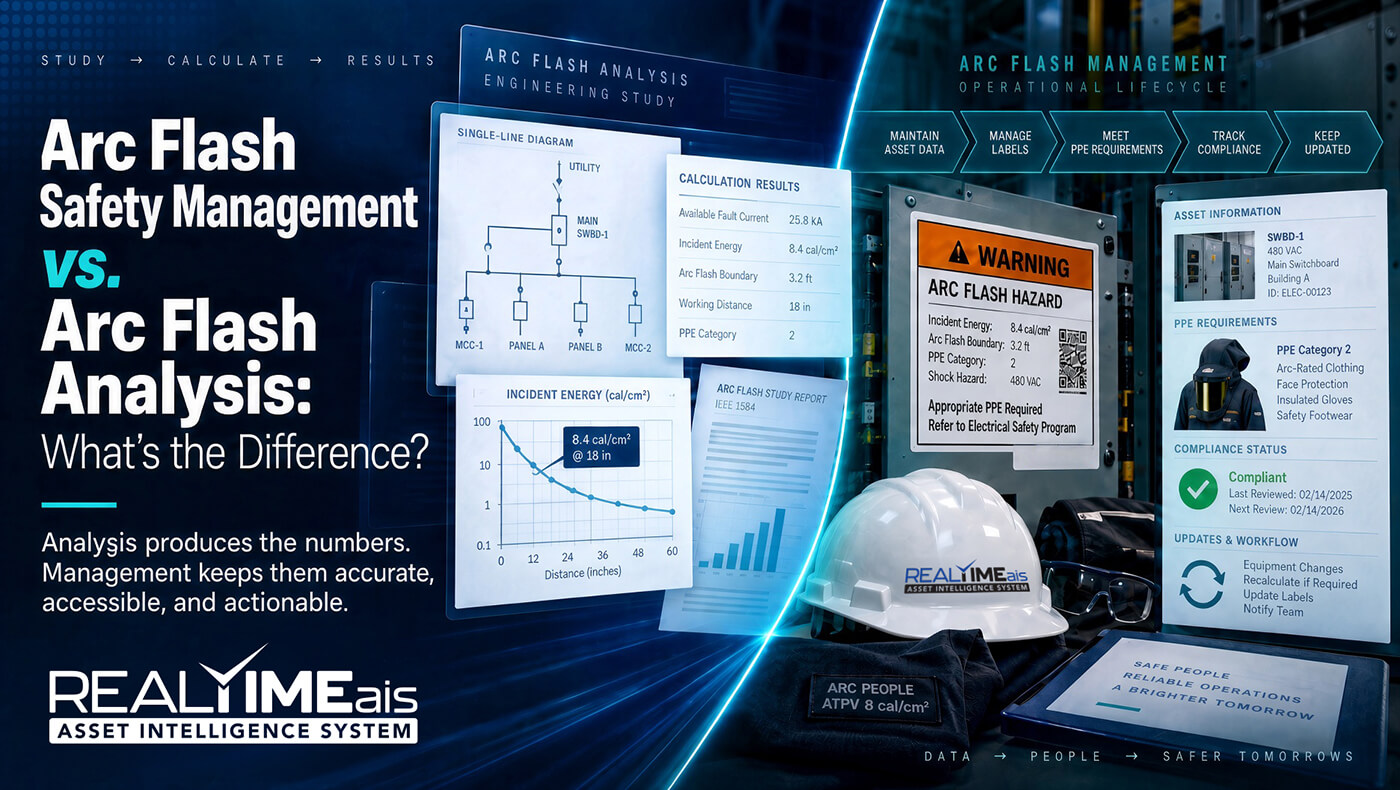


Increasing Program Value by Layering NFPA 70B Activities into Arc Flash Execution
Arc flash assessments have traditionally been conducted as focused engineering exercises: collect system data, run analyses, label equipment, and close the project.
But the field effort required to perform an Arc Flash Assessment (AFA) represents a far greater opportunity.
With NFPA 70B now emphasizing documented maintenance execution, inspection rigor, and condition-based evaluation, organizations can progressively increase the return on their arc flash investment by integrating maintenance-related activities during the same field mobilization.
After working across industrial and commercial systems for over 35 years, I’ve found most organizations fall into four approaches when executing arc flash work – and each provides different opportunities to integrate NFPA 70B tasks and capture additional long-term program value.
The degree of value realized largely depends on how intentionally those activities are integrated into the work.
Below is a structured overview of the approaches – and how each can deliver progressively greater benefit by doing more while completing the AFA.
Approach 1 – Incremental Execution
Baseline Focus: Hazard Identification
This approach performs arc flash work in phases – by area, building, or voltage class – typically driven by budget or outage constraints.
Traditional AFA Activities
- Equipment data collection
- Nameplate capture
- Protective device documentation
- Limited diagram updates
An additional 70B Value That Can Be Captured
Even at this early maturity level, organizations can increase return by adding:
- Basic visual equipment condition observations
- Enclosure integrity checks
- Environmental exposure notes
- Asset identification verification
- Maintenance history flagging
Result
Arc flash work begins supporting maintenance awareness rather than existing solely as a compliance action.
Value Gain:
Improved documentation readiness and asset visibility with minimal added effort.
Approach 2 – Sectional Engineered Assessments
Baseline Focus: Accurate System Modeling
A full engineering study is completed within defined system boundaries.
Traditional AFA Activities
- Detailed verification
- One-line development
- Coordination modeling
- Label generation
Expanded 70B Integration
Because system access and shutdown planning already exist, additional value can be captured through:
- Infrared thermography scans
- Detailed inspection logging
- Panel interior condition documentation
- Photo archiving
- Asset inventory expansion
- Preliminary condition prioritization
Result
Engineering mobilization now contributes directly to maintenance planning.
Value Gain:
Significant increase in condition awareness and documentation depth without additional site visits.
Approach 3 – Table Method or Simplified Strategy
Baseline Focus: PPE Determination
Organizations that rely on NFPA 70E tables often have limited engineering data.
Traditional AFA Activities
- Equipment categorization
- Task-based risk classification
Opportunity to Expand 70B Alignment
Substantial value can still be added through:
- Structured equipment inventory
- Preventive maintenance documentation
- Visual inspection records
- Infrared surveys
- Asset tagging and traceability creation
Result
Even a simplified approach can evolve into structured maintenance documentation.
Value Gain:
Transforms a basic compliance method into a documented maintenance foundation.
Approach 4 – Integrated Lifecycle Execution
Baseline Focus: System Intelligence
This approach treats the arc flash assessment as a multi-objective data capture event supporting a long-term reliability strategy.
Integrated AFA + 70B Activities
- Arc flash modeling inputs
- Infrared thermography
- Visual inspections
- Condition scoring
- Maintenance execution logging
- QR-based asset tracking
- Digital one-line synchronization
- Photo/video documentation
- Sensor integration planning
- Maintenance interval optimization
Result
Every mobilization improves system intelligence, not just study accuracy.
Value Gain:
Maximum lifecycle ROI, strongest compliance defensibility, and reduced long-term engineering cost.
Strategic Perspective
Organizations often ask:
“Which arc flash approach is best?”
The more meaningful question is:
“How much additional program value are we capturing while performing the work?”
As NFPA 70B elevates expectations around documented maintenance execution, forward-looking programs are leveraging arc flash efforts to simultaneously advance:
- Asset digitization
- Inspection completion
- Maintenance documentation
- Condition awareness
- Reliability planning
This shift transforms arc flash execution from a periodic compliance exercise into a driver of electrical system intelligence.