

1. Why This Distinction Matters
If you search for “arc flash software,” the results are dominated by power system analysis tools: ETAP, EasyPower, SKM PowerTools, CYME. These are engineering platforms that perform the mathematical calculations behind an arc flash study — short-circuit analysis, protective device coordination, and incident energy calculations per IEEE 1584.
These tools are essential. Every facility needs an arc flash study performed by a qualified engineer using one of these platforms. Without the study, there are no incident energy values, no PPE requirements, no arc flash labels, and no approach boundaries.
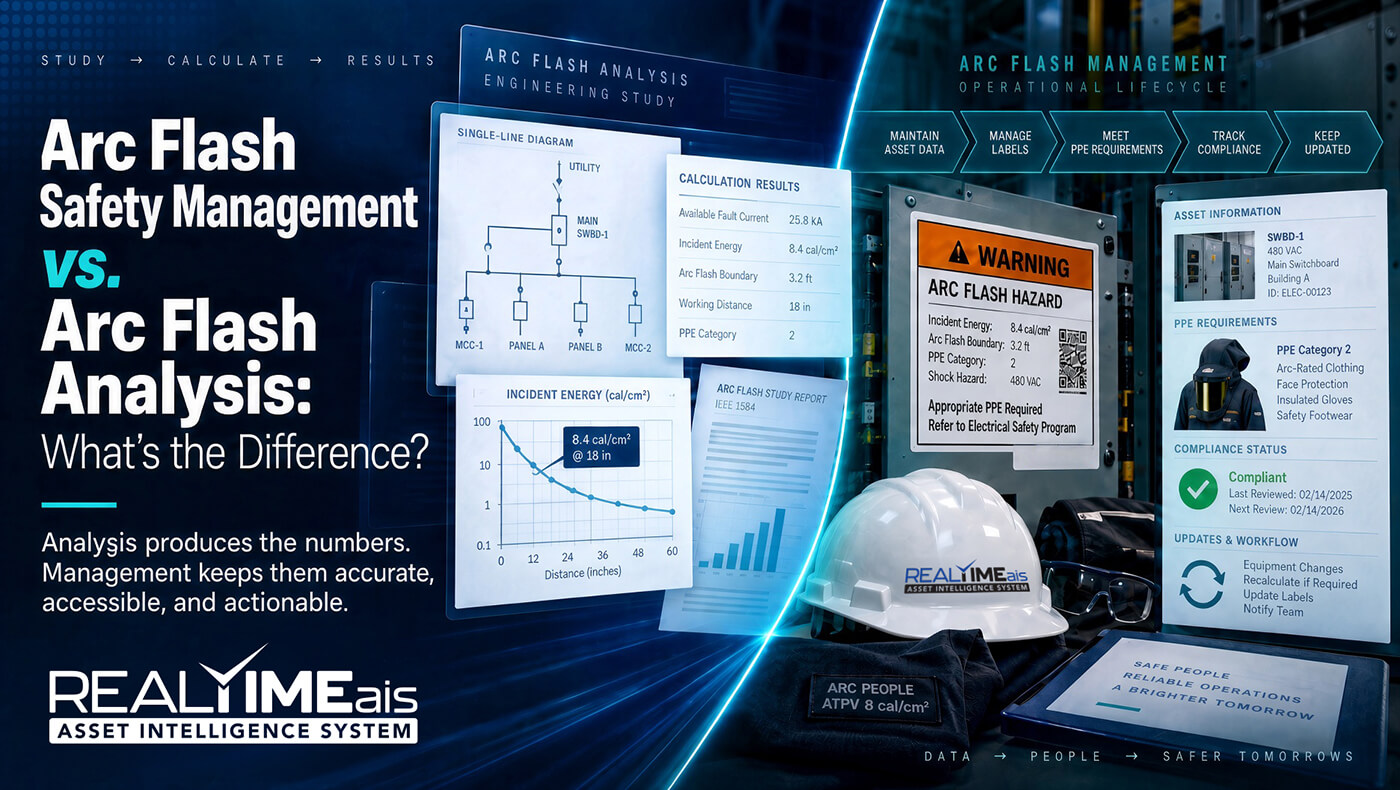
But here is the gap that nobody talks about: what happens to the arc flash data after the study is complete? The engineering firm delivers a report. The report goes into a binder or a shared drive. The data is supposed to be applied to arc flash labels on every piece of equipment, translated into PPE requirements for every worker, communicated through training programs, and kept current for five years until the next study. That entire lifecycle — from study delivery to the next study — is arc flash safety management. And it is where most organizations fail.
This article explains the difference between arc flash analysis and arc flash management, why you need both, and where each one fits in your electrical safety program.
2. Arc Flash Analysis: The Engineering Discipline
Arc flash analysis is a power systems engineering discipline. It produces the quantitative data that drives every arc flash safety decision in the facility. The analysis involves three sequential studies:
2.1 Short-Circuit Study
Calculates the maximum available fault current at every point in the electrical distribution system. This data is essential for verifying protective device ratings and is a primary input to the incident energy calculation. The study uses a model of the electrical system (built from the single-line diagram) to simulate fault conditions at each bus, panel, and connection point.
2.2 Protective Device Coordination Study
Evaluates whether the protective devices (circuit breakers, fuses, relays) in the system are configured to operate in the correct sequence: the device closest to a fault should trip first, isolating the faulted circuit while keeping the rest of the system energized. The coordination study produces time-current curves that show how each device responds to different fault current levels and identifies any miscoordination points where an upstream device may trip before the downstream device.
2.3 Incident Energy Analysis
Calculates the thermal energy (in calories per square centimeter) that would be released during an arc flash event at each point in the system. The calculation uses the available fault current from the short-circuit study, the protective device clearing time from the coordination study, and the working distance (the distance between the worker and the potential arc source). The result is an incident energy value for every bus, panel, and switchgear compartment in the system.
These three studies are performed using specialized power system analysis software — ETAP, EasyPower, SKM, or CYME — by a qualified power systems engineer. The deliverable is an engineering report containing the calculated values for every point in the system. Under NFPA 70B-2026, these studies must be performed at intervals of no more than five years and updated whenever the electrical system changes.
The Bottom Line on Analysis
Arc flash analysis produces numbers. Specific, calculated, engineering-grade numbers for every point in your electrical system. Without these numbers, you cannot determine what PPE workers need, where the arc flash boundaries are, or what information goes on arc flash labels. Analysis is non-negotiable. But analysis is also periodic — it happens once every five years. What happens between studies is where management takes over.
3. Arc Flash Management: The Operational Discipline
Arc flash management is the ongoing, day-to-day process of keeping the data produced by the arc flash study accurate, accessible, and actionable. It covers the full lifecycle between studies and ensures that safety decisions are based on current, correct information.
3.1 Incident Energy Data Management
Every asset in the facility has an incident energy value from the most recent study. That value must be stored in a system where it can be referenced by anyone who needs it — safety managers, maintenance technicians, contractors, supervisors. It must be linked to the specific study that produced it, with the study date, the methodology used, and the system configuration at the time. If the value lives only in a 300-page engineering report, it is functionally inaccessible at the moment of decision.
3.2 PPE Requirement Management
Based on the incident energy value at each asset, the appropriate PPE must be determined per NFPA 70E. The minimum arc rating for clothing, face and head protection, hand protection, and any additional requirements must be documented per asset and accessible to every worker before they begin work on that equipment. PPE requirements must update when incident energy values change — whether from a new study or from a system modification that affects the calculation.
3.3 Arc Flash Label Management
Every piece of electrical equipment must display an arc flash label. The NEC 2026 edition expanded the required label content to include nominal system voltage, arc flash boundary, incident energy or PPE category, minimum required PPE, and the date of the assessment. Managing labels means tracking which labels are current, which need updating (because a new study was performed or the system changed), and which are missing entirely. At scale — a facility with 500+ labeled assets — this is a significant operational task that requires a systematic tracking system.
3.4 Approach Boundary Documentation
NFPA 70E defines three approach boundaries for energized equipment: the limited approach boundary, the restricted approach boundary, and the arc flash boundary. These boundaries must be documented per asset and referenced during every work planning activity. Workers and supervisors need to know the boundaries before approaching equipment, not after an incident.
3.5 System Study Lifecycle Tracking
Under NFPA 70B-2026, arc flash studies expire after five years. The management system must track when each study was performed, when the next study is due, and what system changes have occurred since the last study that might trigger an interim update. A transformer replacement, a utility upgrade, a protective device setting change — each of these can invalidate the existing study data and trigger a mandatory update. Without systematic tracking, these change events accumulate unnoticed and the study data silently becomes inaccurate.
3.6 Condition-of-Maintenance Integration
The NFPA 70B 2026 edition clarified that equipment condition — as documented through the 70B maintenance program — directly affects arc flash risk. A switchgear lineup with deteriorating connections, degraded insulation, or failed protective devices presents a higher probability of an arc flash event than well-maintained equipment. Arc flash management must integrate with equipment maintenance data so that condition changes trigger safety reassessments. This is where arc flash management and NFPA 70B compliance converge.
4. Analysis vs. Management: The Complete Comparison
| Dimension | Arc Flash Analysis | Arc Flash Management |
|---|---|---|
| What it is | An engineering discipline that calculates incident energy values using power system modeling software | An operational discipline that manages the resulting safety data on a daily basis for the full lifecycle between studies |
| Who does it | Power systems engineers (in-house or contracted engineering firms) | Safety managers, facility managers, maintenance teams — the people responsible for keeping workers safe every day |
| When it happens | Every 5 years (mandatory per NFPA 70B-2026) or after system changes | Every day — whenever anyone plans work on electrical equipment, updates a label, or evaluates PPE requirements |
| Tools used | ETAP, EasyPower, SKM PowerTools, CYME — specialized power system analysis software | REALTIME Risk (REALTIMEais) — purpose-built for ongoing arc flash data management integrated with equipment maintenance |
| Primary output | An engineering report with calculated incident energy values at every point in the system | Accessible, current, per-asset safety data: incident energy, PPE, boundaries, label status, study currency, condition linkage |
| Duration of value | The numbers are valid from the study date until the system changes or five years elapse — whichever comes first | Continuous — the management system operates every day between studies and persists across multiple study cycles |
| Cost structure | One-time project cost every 5 years (engineering firm fees, typically $10K–$100K+ depending on system size) | Annual subscription for the management platform plus the operational cost of maintaining data currency |
| Failure mode | Outdated study — numbers no longer reflect the current system configuration | Inaccessible data — correct numbers exist somewhere but workers cannot find or use them at the point of decision |
| Regulatory driver | NFPA 70B Chapter 6 (system studies), IEEE 1584 (calculation methodology) | NFPA 70E (worker safety), NEC 2026 Section 110.16 (labeling), NFPA 70B (condition of maintenance linkage) |
5. The Five-Year Lifecycle Gap
Here is the practical problem. An arc flash study costs $10,000–$100,000+ depending on system size. It is performed by a qualified engineering firm over a period of weeks or months. When the study is delivered, it represents the most accurate snapshot of arc flash risk in the facility at that moment.
Then five years pass.
During those five years, the utility changes available fault current. Transformers are replaced. Protective devices are swapped, recalibrated, or have their settings adjusted. Loads are added or removed. New generation sources come online. Each of these changes potentially invalidates some or all of the study data. And between studies, the engineering analysis tool sits idle — it performed its function and will not be needed again until the next study cycle.
Arc flash management fills this five-year gap. It tracks which study data is current and which has been invalidated by system changes. It flags when the five-year interval is approaching. It ensures that arc flash labels reflect the most recent data. It connects equipment condition changes to safety risk reassessment. And it makes the data accessible to every person who needs it, every day, at the moment of decision — not locked in an engineering report that sits on a shelf.
6. Why Most Organizations Fail at Arc Flash Management
Most organizations invest in the analysis but neglect the management. Here are the five most common failure modes:
Failure 1: The Study Report Becomes Shelfware
The engineering firm delivers a comprehensive report. It goes into a binder in the engineering office. The safety manager has a copy. Maintenance technicians may or may not know it exists. When a worker needs to know the incident energy on a specific piece of equipment, they cannot find the report, cannot navigate a 300-page document to find the right page, or are working in the field with no access to the office where the binder lives.
Failure 2: Labels Are Never Updated
The study is complete and the results show that several pieces of equipment need new arc flash labels. But generating labels, printing them, and physically applying them to every piece of equipment is a project that requires time, coordination, and budget. It gets deferred. The old labels remain. Workers rely on outdated incident energy values and PPE requirements.
Failure 3: System Changes Are Not Tracked
A transformer is replaced. A breaker is upgraded. The utility notifies the facility of a fault current change. Each of these events should trigger a review of the affected arc flash data — but without a systematic tracking process, the changes go unrecorded. The study data quietly becomes inaccurate. The labels display numbers that no longer reflect reality. Workers trust the labels.
Failure 4: Maintenance Condition Is Disconnected from Safety Data
The maintenance team discovers a thermal anomaly on a switchgear bus connection — a Level 2 condition finding under NFPA 70B. This equipment condition change has safety implications: deteriorating connections increase the probability of an arc flash event. But the safety manager does not know about the maintenance finding because the maintenance data and the safety data live in separate systems. The PPE requirements and approach boundaries for that equipment are not reassessed.
Failure 5: Nobody Owns the Management Lifecycle
The engineering firm owns the analysis. But who owns the management? In many organizations, no one does. The safety manager assumes maintenance handles it. Maintenance assumes the safety department handles it. The engineering firm assumes the client handles it. The result is that no one systematically manages the data between studies. Five years pass, and the facility is effectively operating on arc flash data that no one has verified, maintained, or connected to equipment condition changes.
7. The Solution: Analysis + Management Together
The solution is not to choose between analysis and management. You need both. They are sequential disciplines that together form a complete arc flash safety program:
Step 1: Perform the analysis. Engage a qualified engineering firm to conduct the arc flash study using ETAP, EasyPower, or equivalent analysis software. This produces the engineering data: incident energy values, available fault current, protective device coordination status, arc flash boundaries.
Step 2: Import the results into a management platform. Load the study data into REALTIME Risk by asset. Each piece of equipment gets its incident energy value, PPE requirements, approach boundaries, and study metadata (date, firm, methodology, system configuration).
Step 3: Apply the data. Generate arc flash labels from the management platform. Update PPE requirements across all work procedures. Train workers on the current values. Document everything.
Step 4: Manage the lifecycle. Track system changes that affect the data. Flag studies approaching the five-year interval. Monitor equipment condition for changes that affect arc flash risk. Keep labels current. Keep PPE requirements current. Keep the data accessible.
Step 5: Repeat. When the next study is performed, import the new results into the same management platform. The system retains historical data from the previous study so you can track how incident energy values change over time. Labels are updated systematically. PPE requirements are recalculated. The management lifecycle continues.
How REALTIMEais Completes Your Arc Flash Program
REALTIMEais does not replace your arc flash analysis tool — it completes it. REALTIME Risk picks up where ETAP and EasyPower leave off, managing the study results for the full lifecycle between analyses. Import study data by asset. Track incident energy, PPE, boundaries, and labels. Monitor the five-year interval and system change triggers. Connect arc flash safety data to equipment condition data through the REALTIME Tool integration. One platform managing both NFPA 70B maintenance compliance and NFPA 70E arc flash safety — the two standards that the 2026 edition explicitly links through the “condition of maintenance” requirement.
8. Frequently Asked Questions
Q: Can REALTIME Risk replace ETAP or EasyPower?
No. REALTIME Risk is not an arc flash calculation tool. It is an arc flash data management platform. You still need ETAP, EasyPower, SKM, or equivalent software (or an engineering firm that uses them) to perform the arc flash study. REALTIME Risk manages the results of that study for the five-year lifecycle between analyses.
Q: Can I use REALTIME Risk without performing an arc flash study first?
You need study data to populate REALTIME Risk with incident energy values, PPE requirements, and approach boundaries. If you do not have a current arc flash study, the first step is to commission one. REALTIME Risk can manage existing study data immediately upon import.
Q: How does REALTIME Risk import data from ETAP?
REALTIME Risk accepts arc flash study data from ETAP including incident energy values, available fault current, protective device settings, and system configuration metadata. The import process maps study results to individual assets in the REALTIMEais platform. Contact us for specific integration details.
Q: What happens when I get a new arc flash study in five years?
Import the new study results into REALTIME Risk. The platform retains historical data from the previous study, so you can track how incident energy values have changed. The system identifies every asset where the incident energy value changed and flags labels and PPE requirements that need updating.
Q: Does the condition-of-maintenance linkage actually affect arc flash risk?
Yes. NFPA 70B-2026 explicitly states that the condition of maintenance of electrical equipment is a factor in determining the likelihood of an arc flash event. Deteriorating equipment (loose connections, degraded insulation, failed protective devices) is more likely to produce a fault that results in an arc flash. The condition data from your 70B program directly informs the risk assessment under 70E.
⸻
Complete Your Arc Flash Safety Program
Your arc flash analysis tool produces the numbers. REALTIME Risk manages them. See how arc flash management closes the five-year lifecycle gap and connects your safety data to your equipment maintenance program.
Request a Demo Today
Call 866-558-4313 | Visit realtimeais.com/demo