
1. The Question Every Facility Manager Asks
“We already have a CMMS. Can’t we just use it for NFPA 70B?”
It’s a reasonable question. Your organization has already invested in a Computerized Maintenance Management System — maybe eMaint, UpKeep, Limble, Fiix, Maximo, or one of dozens of other platforms. It manages work orders, tracks assets, schedules preventive maintenance. Adding electrical equipment to the same system seems logical.
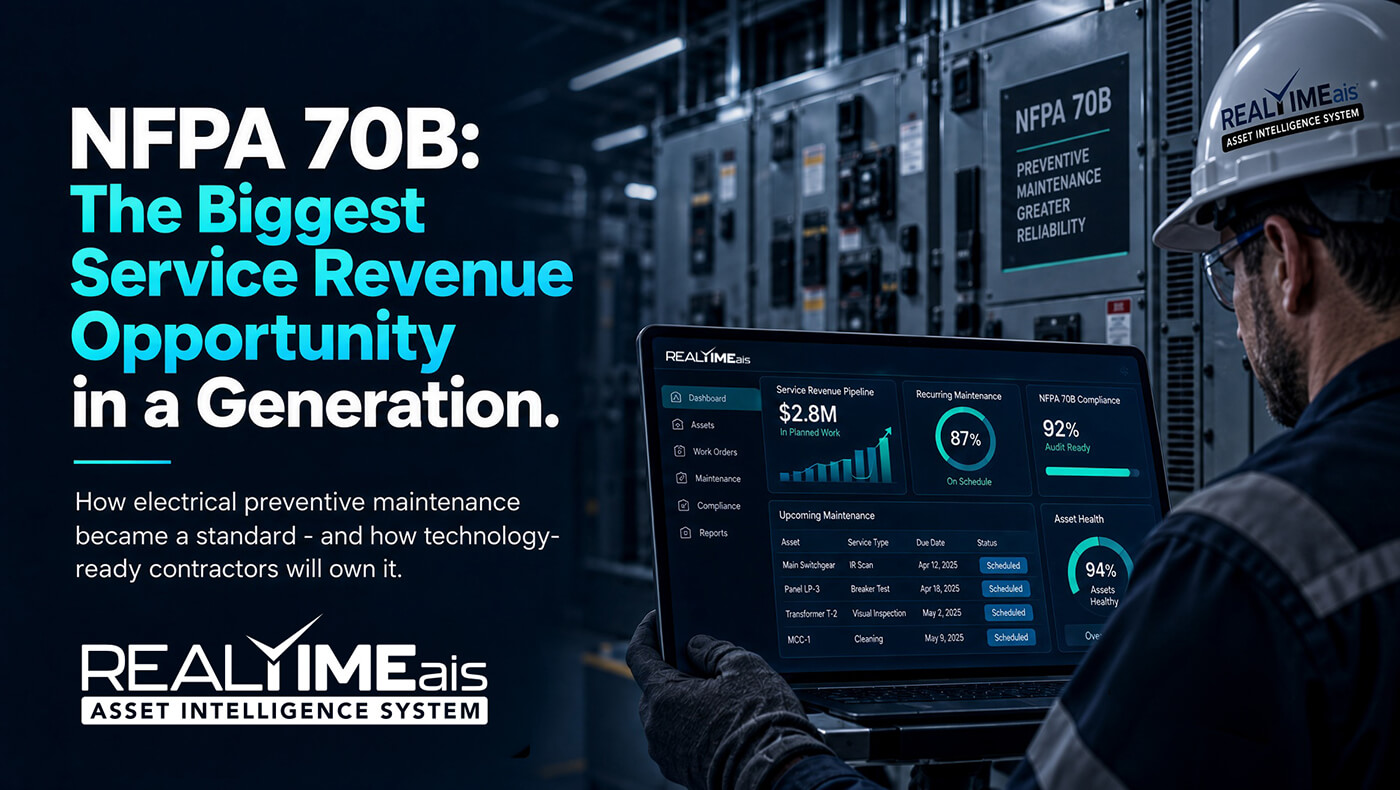
The short answer: your CMMS can manage work orders for electrical equipment. It cannot manage NFPA 70B compliance. The distinction matters — and since NFPA 70B became a mandatory standard in 2023 (with significant updates in the 2026 edition published September 2025), the consequences of getting this wrong have escalated from inconvenient to potentially career-ending.
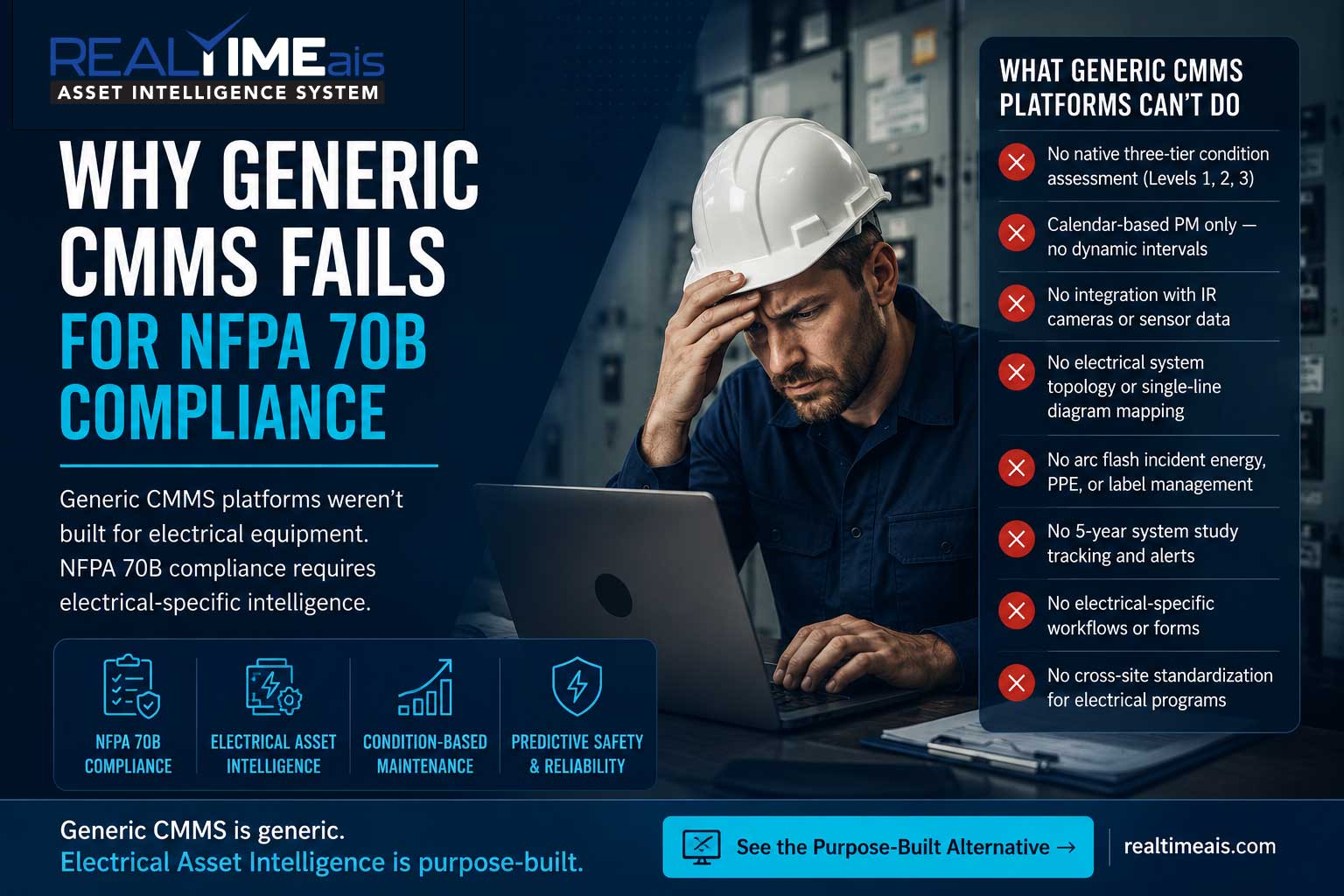
This article explains the seven structural gaps that prevent generic CMMS platforms from delivering NFPA 70B compliance — not because they are bad products, but because they were designed for a different purpose. Understanding these gaps is essential for any facility manager, maintenance director, or safety professional evaluating their compliance strategy.
2. What CMMS Was Actually Built For
Generic CMMS platforms were designed to centralize and automate facility maintenance operations across every asset category: HVAC systems, plumbing, roofing, fire suppression, elevators, generators, and — yes — electrical equipment. They are work order management systems at their core. They do several things well:
They create, assign, and track work orders. They schedule recurring preventive maintenance tasks on calendar-based intervals. They maintain a general asset registry. They track inventory and spare parts. They generate maintenance history reports. They manage technician assignments and labor tracking.
For general facility maintenance — HVAC filter changes, plumbing repairs, roof inspections, elevator service — these capabilities are exactly what you need. The problem arises when you try to use this general-purpose architecture for a specific, regulation-driven compliance program that has its own logic, its own data model, and its own operational requirements.
NFPA 70B is not a work order program. It is a condition-based compliance framework with dynamic scheduling, multi-standard integration, live sensor data, and audit-grade documentation requirements. Generic CMMS was never designed for this.
3. The Seven Structural Gaps
Gap 1: No Condition Assessment Framework
NFPA 70B requires every electrical asset to be assigned a condition level — Level 1 (Good), Level 2 (Fair), or Level 3 (Poor) — based on documented inspection and testing results. The condition level is not a static label; it must be updated after every inspection cycle and directly determines the maintenance interval for that asset.
Generic CMMS platforms do not have a native condition assessment framework. You can create custom fields to store a condition score, but the system does not understand what that score means, does not enforce the three-tier classification, does not link condition scores to maintenance schedules, and does not recalculate intervals when a score changes. You end up managing the most critical element of NFPA 70B compliance in a custom field that has no logic behind it.
What you need: A system where condition levels are first-class data objects that drive maintenance scheduling automatically — not custom fields bolted onto a generic asset record.
Gap 2: Static Scheduling vs. Condition-Driven Intervals
Every generic CMMS on the market schedules maintenance on calendar-based intervals: inspect this breaker every 12 months, test this transformer every 24 months. These intervals are fixed. A piece of equipment in perfect condition gets the same maintenance frequency as one showing early signs of deterioration.
NFPA 70B requires the opposite. Maintenance intervals must be determined by equipment condition. Level 1 equipment follows standard intervals. Level 2 equipment follows shortened intervals (typically 50-75% of standard). Level 3 equipment requires immediate corrective action with maximum-frequency follow-up. When a condition assessment changes — say, a thermographic survey reveals a new hot spot that drops an asset from Level 1 to Level 2 — the maintenance schedule must adjust automatically.
In a generic CMMS, this adjustment requires a human to manually change the PM frequency for that specific asset. In a facility with hundreds or thousands of electrical assets, this manual process is unsustainable. Condition changes get missed, schedules fall out of sync, and the compliance gap widens silently.
Gap 3: No Electrical System Topology
Electrical systems have a specific topology: utility service feeds main switchgear, which feeds distribution panels, which feed branch circuits, which feed individual equipment. This hierarchy matters because a failure at any point in the chain affects everything downstream. A deteriorating main bus connection doesn’t just put one asset at risk — it puts every downstream asset and every person working on downstream equipment at risk.
Generic CMMS platforms use flat asset trees. Every asset is an independent record with a location and a parent-child relationship that reflects physical proximity (Building > Floor > Room > Asset), not electrical connectivity. The system has no concept of feeder relationships, upstream protective devices, or the cascading risk implications of a single-point-of-failure in the electrical distribution hierarchy.
A purpose-built electrical platform models the actual electrical topology — mapping the single-line diagram into the asset hierarchy so that upstream conditions, protective device coordination, and downstream impact are all visible and actionable.
Gap 4: Zero Arc Flash Awareness
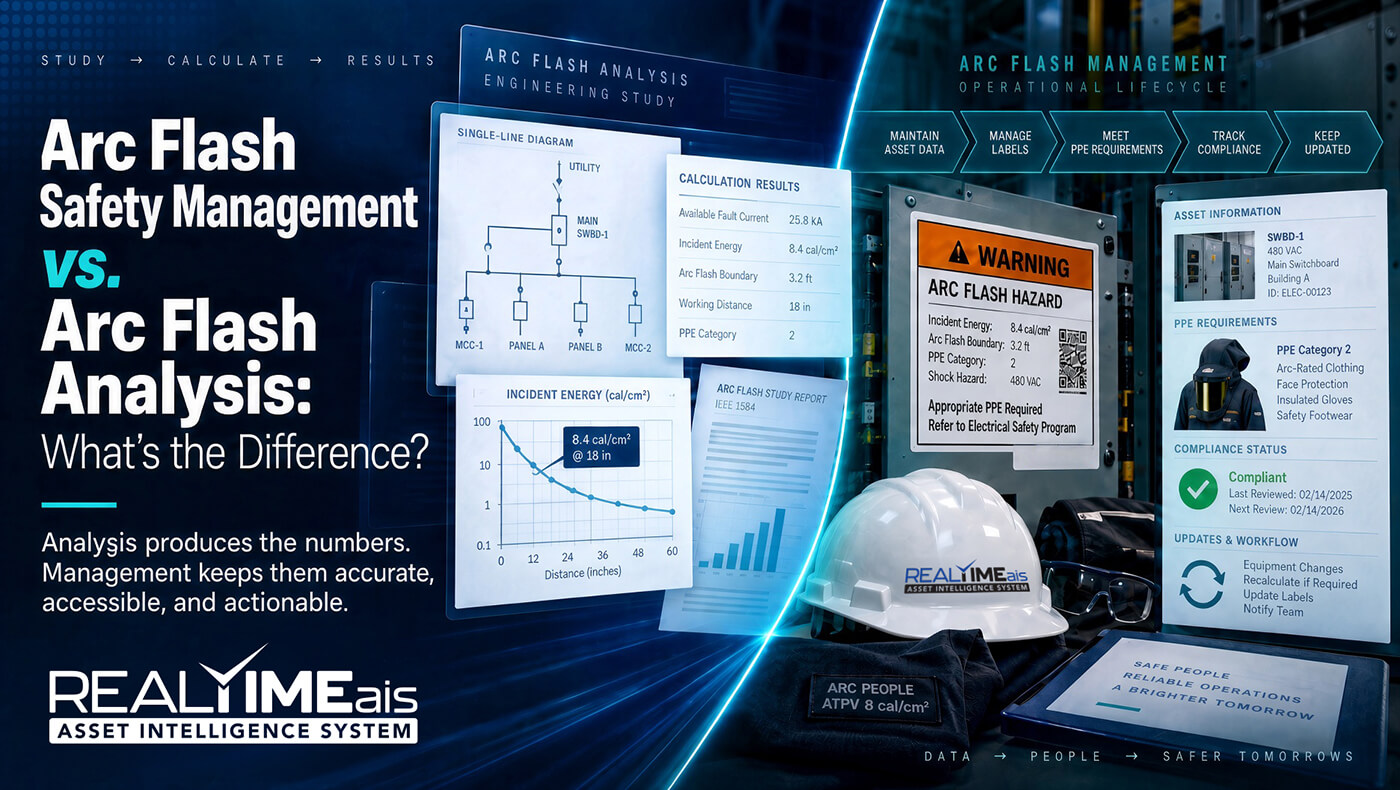
NFPA 70B compliance intersects directly with NFPA 70E arc flash safety. The condition of maintenance of electrical equipment — established through the 70B program — is a factor in determining arc flash risk and PPE requirements under 70E. The 2026 edition of NFPA 70B made this connection explicit: if you cannot demonstrate 70B compliance, you cannot claim a favorable condition of maintenance for 70E purposes.
Generic CMMS has zero awareness of arc flash data. There is no field for incident energy values, no connection between equipment condition and arc flash risk, no mechanism to flag that a condition change should trigger a 70E reassessment, and no way to display approach boundaries or PPE requirements alongside the maintenance work order.
An electrician opening a work order in a generic CMMS sees task instructions. An electrician opening a work order in an electrical intelligence platform sees task instructions plus the asset’s current condition level, incident energy value, required PPE, and approach boundaries — because that information is integral to safely performing the work.
Gap 5: No Sensor Integration for Predictive Maintenance
The NFPA 70B 2026 edition explicitly recognizes continuous monitoring technologies — permanently installed IR cameras, hot-spot sensors, partial discharge detectors, and power quality analyzers — as valid inputs to the condition assessment process. These technologies generate real-time data streams about equipment health that should feed directly into condition scores and trigger maintenance actions.
Generic CMMS platforms cannot ingest live sensor data. They were designed to receive human-generated inputs: a technician submits a work order, a manager approves a PM schedule, an inspector records a finding. The concept of a sensor automatically updating an asset’s condition level and recalculating its maintenance interval is fundamentally outside the CMMS architecture.
As a result, organizations that invest in continuous monitoring technologies (GraceSense HSM, FOTRIC AI cameras, or similar) end up with the sensor data in a standalone vendor dashboard and the maintenance program in the CMMS — two systems that don’t talk to each other, requiring manual correlation by a human who may or may not check both systems regularly.
Gap 6: No NFPA 70B-Specific Maintenance Procedures
Electrical equipment maintenance involves specialized procedures that generic CMMS work order templates do not include. Thermographic inspection protocols with temperature differential thresholds and baseline comparisons. Insulation resistance testing with polarization index calculations. Contact resistance measurements with pass/fail criteria by connection type. Protective device testing with trip-time verification. Power factor testing for insulation systems.
These are not generic tasks like “Inspect unit” or “Perform PM.” They require specific testing parameters, acceptance criteria, and failure response protocols that NFPA 70B defines by equipment type. In a generic CMMS, you would need to manually build every one of these procedures as custom work order templates — and the system still would not enforce the acceptance criteria, link test results to condition levels, or trigger corrective actions when results fall outside acceptable ranges.
Gap 7: No System Study Tracking
The NFPA 70B 2026 edition mandates that short-circuit studies, coordination studies, and incident energy analyses be performed at intervals of no more than five years, with interim updates required whenever the electrical system changes. Tracking these study dates and system change triggers is a core compliance requirement.
Generic CMMS platforms have no native mechanism for tracking system-level studies that span the entire electrical infrastructure. You could create a recurring PM task labeled “Arc Flash Study Due,” but the system cannot track which specific systems have been studied, when each study was last performed, what system changes have occurred since the last study, or which changes trigger a mandatory interim update. This is system-level compliance tracking, not asset-level work order management — and it falls completely outside the CMMS paradigm.
4. Generic CMMS vs. Electrical Asset Intelligence: The Full Picture
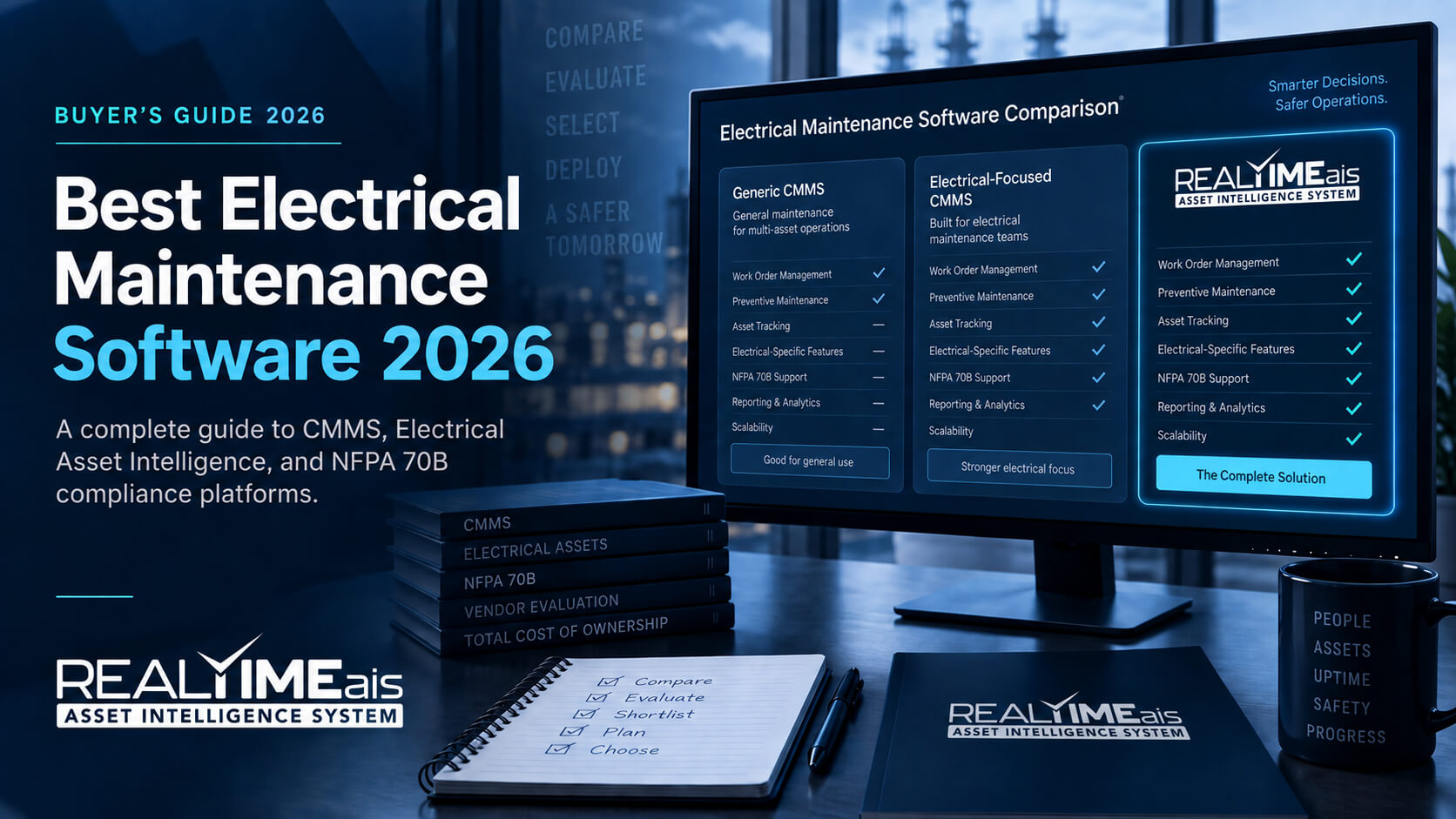
| NFPA 70B Requirement | Generic CMMS | REALTIMEais |
|---|---|---|
| Condition Assessment (Levels 1/2/3) |
❌ Custom fields only — no logic, no enforcement, no scheduling link | ✔ Native three-tier system; scores drive scheduling automatically |
| Condition-Driven Intervals | ❌ Calendar-based only; manual changes required for every interval adjustment | ✔ Intervals recalculate automatically when condition levels change |
| Electrical System Topology | ❌ Flat asset tree based on physical location; no feeder relationships | ✔ Hierarchical topology mapping aligned to single-line diagrams |
| Arc Flash Data Integration | ❌ Not supported; no incident energy, PPE, or boundary data on work orders | ✔ Full IEEE 1584 dataset per asset; safety data visible on every work order |
| Sensor / IoT Integration | ❌ Cannot ingest live data; sensor feeds stay in standalone dashboards | ✔ Live API feeds from FOTRIC AI cameras, GraceSense HSM, and power quality analyzers |
| Electrical-Specific Procedures | ❌ Generic work order templates; no enforcement of acceptance criteria | ✔ NFPA 70B procedures by equipment type with pass/fail criteria and corrective triggers |
| System Study Tracking | ❌ No native mechanism for study-level tracking or change-event triggers | ✔ Five-year interval tracking per system; automated alerts on study due dates and system changes |
| Cross-Site Standardization | ❌ Each site typically runs its own instance or configuration | ✔ Centralized platform enforcing standardized procedures across all locations |
| NFPA 70E Integration | ❌ Separate systems; no link between condition data and safety requirements | ✔ REALTIME Tool (70B) and REALTIME Risk (70E) in one integrated environment |
| Safety Training / LMS | ❌ Not included; managed in a separate LMS or not tracked at all | ✔ REALTIME Worker manages OSHA, NFPA 70E, and arc flash training with qualification tracking |
| Compliance Audit Trail | ❌ Work order history only; no compliance-specific reporting or scoring | ✔ Full compliance audit trail with time-stamped records, condition histories, and on-demand reporting |
5. The Right Tool for the Job
A generic CMMS is a general practitioner. REALTIMEais is a cardiologist. Both are capable professionals. Both can listen to your heart. But if you need heart surgery, you go to the specialist — not because the GP is incompetent, but because cardiac care requires specialized knowledge, specialized tools, and specialized workflows that a general practice cannot provide at the same depth.
Your electrical infrastructure is the cardiovascular system of your facility. Everything depends on it. When it fails, the consequences are catastrophic — arc flash injuries, equipment fires, production shutdowns, regulatory citations, and insurance claims. The maintenance program that protects this infrastructure deserves a purpose-built system, not a generic tool that treats a 4,160V switchgear lineup the same as an HVAC air handler.
6. What This Means for Your Organization
This article is not an argument to rip out your CMMS. Your CMMS does exactly what it was designed to do — manage general facility maintenance — and it should continue doing that. The argument is that electrical equipment compliance under NFPA 70B requires a separate, purpose-built system that your CMMS was never architected to provide.
The practical path forward for most organizations is to keep the CMMS for general facility maintenance (HVAC, plumbing, structural, grounds), implement a purpose-built electrical asset intelligence platform for NFPA 70B compliance and NFPA 70E safety management, and let each system do what it does best.
This is not unusual. Most organizations already use specialized systems alongside their CMMS — building automation systems for HVAC, fire alarm monitoring platforms, security management systems, energy management platforms. Electrical asset intelligence is the same principle applied to the most critical infrastructure in the building.
💡 REALTIMEais: Purpose-Built for Electrical IntelligenceREALTIMEais was designed from the ground up for one purpose: managing electrical infrastructure compliance and safety. Every feature — from the condition assessment engine to the maintenance scheduler to the live sensor integrations to the arc flash data management — exists because NFPA 70B and NFPA 70E require it. No CMMS customization project can replicate what a purpose-built architecture delivers out of the box.
⸻
See What Purpose-Built Looks Like
Request a demo and see how REALTIMEais handles condition assessments, dynamic scheduling, sensor integration, arc flash data, and compliance reporting — all in a single platform your CMMS was never designed to deliver.
Request a Demo Today
Call 866-558-4313 | Visit realtimeais.com/demo